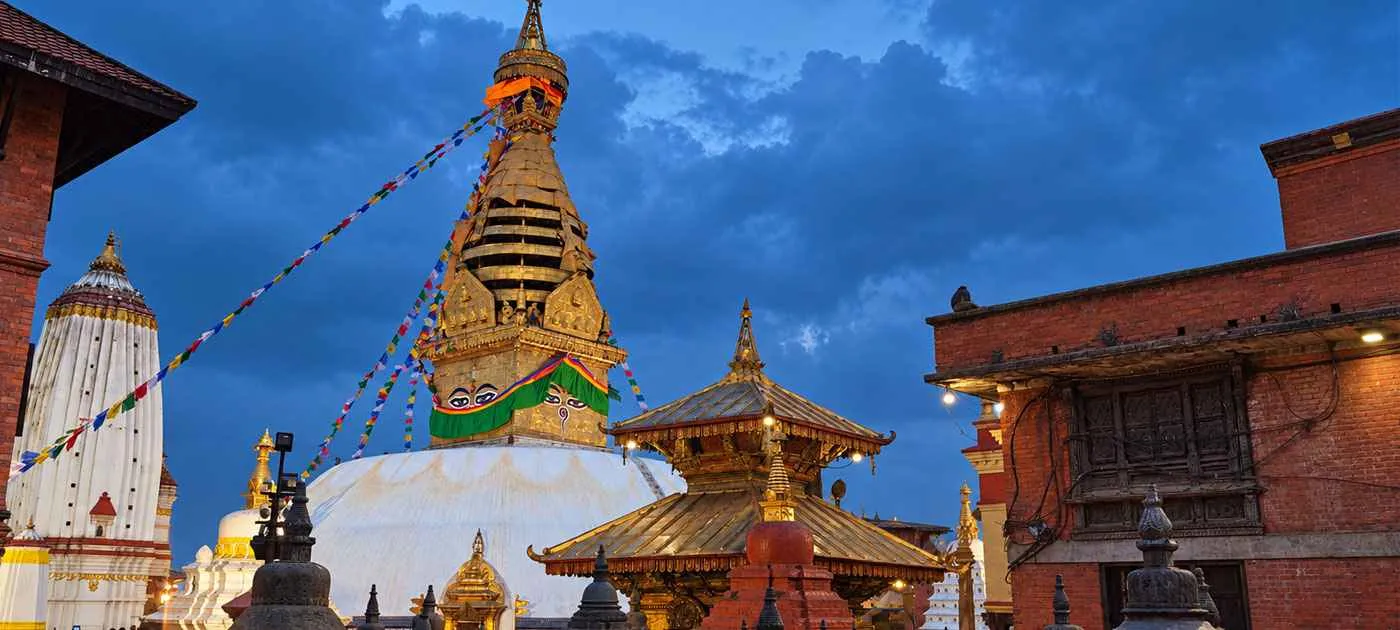
I want to share some wonderful details about Swayambhunath, a famous hilltop Buddhist site in Kathmandu and one of Nepal's UNESCO World Heritage Sites.
Local legend says the entire Kathmandu Valley was once a lake, and this hill stood as an island where a natural flame burned. A visitor from Tibet named Manjushree drained the lake by cutting through a southern hill, allowing people to reach the sacred flame and build the first protective dome. Over the centuries, rulers rebuilt and expanded the site after historical damage.
Visitors often call it the Monkey Temple because hundreds of monkeys live in the surrounding forest, and the catchy nickname is much easier for international tourists to pronounce than the original name.
When you visit, you can experience several remarkable sights:
- Colorful Tibetan prayer flags blowing in the wind
- The large white stupa and the massive golden Buddha eyes
- The World Peace Pond and the traditional thunderbolt symbol
- Panoramic views overlooking the entire Kathmandu Valley
If you plan to explore this open-air museum, our local guides can help you experience its rich history firsthand. WhatsApp me at +9779851043624 for arragement of visiting this site, or book our one-day Kathmandu Heritage tour.
Swayambhunath is a Buddhist site in Kathmandu, located on a hill where you can see the entire Kathmandu Valley. It is one of Nepal's 10 UNESCO World Heritage Sites. Swayambhunath is often called an open-air museum.
The Kathmandu Valley was once entirely covered by water, and Swayambhunath was an island. According to Buddhist legend, Manjushree from Tibet came here, and he saw a natural gas flame on this hill station, which was then named Swayambhunath. Swayambhu has two meanings in Sanskrit. Swayam means itself, and Bhu means the earth. Because of the natural flame, Manjushree thought it was the god's power and named the land after the god himself. He wanted to go to the lake and pray there, but he could not because water surrounded it. Then he went to southern Kathmandu, cut a hill, and made a gorge through which water from the Kathmandu Valley drained out; he went to Swayambhunath and made a small dome to protect the flame. Manjushree had not yet covered the flame. Later, Shantikaracharya covered it all.
The main stupa was negligible until 1406, when the Muslim king Samasuddin destroyed it. King Jayasthiti Malla rebuilt it, and in the 17th century, King Pratap Malla built a larger, more elaborate stupa at Pratappura and Anantapur.
Why is Swayambhunath known as Monkey Temple?
Swayambhunath (meaning "the earth is god itself") is the place's original name; later, it became known as the Monkey Temple. We see many monkeys here because the hill has an extensive forest where they can live, and because of them, the place is more popular as the Monkey Temple. Pronouncing Swayambhunath could be difficult for tourists, making the Monkey Temple more accessible. Among tourists, this place is more popular as a monkey temple than Swayambhunath.
Things to See in Swayambhunath
- Colorful Tibetan Buddhist prayer flags
- World Peace Pond (wishing pond)
- Monkeys and Monkey’s Swimming Pool
- Giant white Stupa (Buddhist temple)
- Thunderbolt (Bajra)
- Harati Temple (Temple of pneumonia)
- View of Kathmandu Valley
- Antique shops and more
This is general information about Swayambhunath; please contact us if you want to visit. We provide a knowledgeable and helpful tour guide for detailed information about this place.