
19-day Everest High Passes ot Threre Passes Trek with actual 15 days walk, two days for arrival and departure, one day Kathmandu cultural heritage tour, and one day to travel from Lukla to Kathmandu is the most adventurous mountain trip in the Everest Region, Nepal that goes to the maximum of 5,550 m / 18,208 ft, Kala Patthar and 5,535 m / 18,159 ft Kongma La which costs 1,550-1,799 USD according to the number of trekkers in one group that includes three nights hotel accommodation with breakfast in Kathmandu, all trek permits, all meal with guesthouse accommodation in the mountain, Lukla round flight, and a proffesional guide.
Everest Three High Pass Trek
Trip Facts
Duration
19 Days
Trip Grade
Strenuous
Country
Nepal
Maximum Altitude
5,550 meters
Starts
Kathmandu
Ends
Kathmandu
Group Size
1-10
Activities
Trekking and Cultural Tour
Best Time
October to November and March to May
A Quick Glimpse
- Trip Duration: 19 Days
- Trekking Duration: 15 Days
- Starting Point: Kathmandu
- Ending Point: Kathmandu
- Maximum Elevation: 5,550 meters (18,208 feet)
- Difficulty Level: Strenuous
- Best Seasons: October to December and March to May
- Key Highlights: Mountain views, adventure high passes, scenic flight to Lukla, traditional Sherpa villages with typical architectural houses, cultural and religious monuments, wildlife, rivers, valleys, waterfalls, crossing massive glaciers, stunning viewpoints, tranquil lakes, and more
- Mountain Views: Everest, Lhotse, Makalu, Cho-Oyu, Pomori, Ama Dablam, and hundreds more
- Customizable: Yes
The Everest High Passes Trek involves crossing three significant hills, which is why it's also known as the Everest Three Passes Trek. It is the most adventurous trekking trip in the Khumbu-Everest Himalayas, and it can be done clockwise or counter-clockwise.
Trekking to the Everest Three Passes begins in Lukla after a short scenic flight from Kathmandu or Ramechhap (Manthali). You stay with the same Everest Base Camp Trek itinerary until Namche Bazaar for the first three days of this trip, even if you take clockwise or anti-clockwise routes.
This Adventure Everest Three Passes Trek offers all the attractions of the Everest region, including iconic high mountains, captivating landscapes, scenic valleys, charming nature, pristine lakes, ancient Buddhist monasteries and monuments, and more. If you are adventurous and plan to visit the mountain regions, often spending around 3 Weeks in Nepal, this Trek can be the best for you. Now, let's have some information on two different Trekking routes of the Everest Three High Passes Trek here:
Clockwise Trekking Routes of the Everest Three Passes Trek
Clockwise Trekking Routes to the Everest Three High Passes Trek go left from Namche Bazaar to Thame on the fourth day. Then, you ascend to Lungden on the fifth day and go over Renjo La Pass to Gokyo Lakes. Then, you visit Gokyo Ri and cross Ngozumpa Glacier before reaching Thangnak to go over Cho La Pass. Now, you Trek to Everest Base Camp and return to Lobuche to cross Kongma La Pass over the Khumbu Glacier. After the final High Pass, Kongma La, you reach Chhukung, visit Chhukung Ri, and then trek down to Lukla through Dingboche, Tengboche, Namche, and Phakding. Check out the outline Itinerary for the Clockwise Everest Three Pass Trekking below:
Day 1: Fly to Lukla (2840m) and Trek to Phakding (2610m). 3 hours
Day 2: Trek to Namche Bazaar (3440m) 6-7 hrs
Day 3: Rest in Namche Bazaar and hike to Hotel Everest View (3880m) for 4 hours.
Day 4: Trek to Thame (3750m) 4-5 hrs
Day 5: Trek to Lungden (4500m) 6 hrs
Day 6: Trek to Gokyo (4790m) via Renjo La Pass (5360m) 8 hrs
Day 7: Hike to Gokyo Ri (5357 m) for 2 hours and overnight in Gokyo.
Day 8: Trek to Thangnak/Drangnak (4700m) 3hrs
Day 9: Trek to Zong La (4855m) via Cho La Pass (5360m) 7-8 hrs
Day 10: Trek to Gorakshep (5180m) for 5–6 hours and hike to Kala Patthar (5550m). 2 hrs
Day 11: Hike to Everest Base Camp (5364m) and Trek back to Lobuche (4910m). 6-7 hrs
Day 12: Trek to Chhukung (4730m) via Khumbu Glacier and Kongma La Pass (5535m) 8-9 hrs
Day 13: Trek to Tengboche (3860m) 6 hrs
Day 14: Trek back to Manche Bazaar (3440m). 5 hrs
Day 15: Trek to Lukla (2840m) 7 hrs
Day 16: Fly out to Kathmandu
Note: The Clockwise Everest Three Passes Trek Itinerary can be adjusted to suit your time and physical fitness.
Counter-Clockwise Route for the Everest Three Passes Trek
The Counter-Clockwise Trekking Itinerary of the Everest High Passes Trek is comparatively more straightforward than the Clockwise one. This Route goes to Everest Base Camp first, then to the Gokyo Lakes, and finally to Thame. At the start of this Anti-Clockwise Everest Three Passes Trek from Lukla to Namche Bazaar, the Itinerary goes right towards Tengboche Hill on the fourth day.
You go to Dingboche and Chhukung and go over the Kongma La pass to cross the first hill of the Three Big Hills. Now, you Trek to Everest Base Camp and go over the Cho La Pass to visit Gokyo Lakes and Gokyo Ri. After spending a few nights in Gokyo, you go over Renjo La and reach the Himalayan hidden valley (Thame) before meeting Namche Bazaar. Then, you Trek to Lukla to fly out to Kathmandu at the end of the trip. For the detailed Itinerary of the Anti-Clockwise Everest Three Passes Trek, check our package's Itinerary section.
Everest High Passes: Clockwise vs. Anti-Clockwise Route
You can find two trekking itineraries for the Everest High Passes online, taking Clockwise and Anti-Clockwise routes. It might make choosing the Route challenging. What are the differences between these two routes of the Everest Three Passes? Which Route is more difficult to take? Check them out below:
The counter-clockwise Route is more straightforward and has less climbing than the Trek's clockwise Route. You can see the altitude variation in the Itineraries between these two routes. If you take the anticlockwise trail, you do not miss visiting the world's highest mountain base camp, but if you get tired from the first Pass, you may miss the chance of going to Everest Base Camp from the Clockwise route.
Everest Three Passes Trek Cost
The Cost of the Everest Three Passes depends on the services offered, the length of the trip, and the group size. Hiring just a guide costs less than an all-inclusive trip, but at the end of the Trek, the expenses are similar to those of an all-inclusive trip, even if you pay for food and lodges in the mountains.
It costs 1550-1625 USD for a single trekker, but the cost might be lower if you book this trip as part of a group. Check the Trek Cost for the Everest High Passes according to the group size below:
| Pax | Cost | Booking |
| 1 | 1,799 USD | Book Now |
| 2-4 | 1699 USD | Book Now |
| 5-10 | 1550 USD | Book Now |
We provide special discounts for family and group bookings of more than 4 people for this Trekking Package. To get a better offer, contact us through WhatsApp or direct email.
Preparation for Adventure Treks and Everest High Passes
Crossing the Three High Passes is difficult, so you must be physically fit and mentally prepared for this Trek. Make it your mindset to face any difficulties on the High Pass Trail. Mind control is for the body, so I can do it if you make your mind strong and think. Then, it makes you more comfortable.
After the mental preparation, you must be physically fit for this adventurous Trek. To practice altitude climbing, visit high altitudes above 4000m in the Himalayas, such as the Annapurna Base Camp Trek in Nepal, a couple of times.
Start hiking regularly, or at least once a week, on the uphill and downhill trails for a few hours with 5–6 Kg of weight on your back. You can also do some physical exercise and juggling every day for about a month, along with leg exercises targeting the thighs, knees, calves, and ankles. You have many uphill and downhill trails for many days, so this type of trail can cause body and leg pain if you are not a regular hiker or have not done any physical exercises.
What to Expect from the Everest High Pass Adventure Trek
The first thing to expect from this High Pass Trek is the pride of an adventure. Walking through traditional villages and lush forests for the first few days after the scenic flight to Lukla, you reach the open surroundings and see magnificent mountain views.
On the Everest Three Passes Trek in the Everest region, you walk through charming valleys and see captivating landscapes. Vantage points like Hotel Everest View, Tengboche Hill, Nangkartshang Hill, Kala Patthar, Kongma La Pass, Cho La Pass, Gokyo Ri, and Renjo La Pass offer alluring views of the high mountains, including the four highest mountains above 8,000 meters.
In the adventure, you will also walk on two famous glaciers, Khumbu and Ngozumpa. TrekTrek's outstanding achievement is reaching the summit of the world's tallest mountain. Another attraction of the trip is seeing pristine glacial lakes such as the Gokyo Lakes. In addition to the natural attractions, seeing wildlife and religious monuments adds extra excitement to the Everest High Pass Trek. You will surely love the great hospitality from the locals during your Everest High Pass journey.
Everest High Pass: What makes TrekTrek difficult?
The considerably challenging adventure, the High Passes Trek, is altitude sickness. Coming from sea level and flying directly to Lukla (2840m) is already high enough. You reach 5500 m+, plus, within a few days of walking, but you have some acclimatization rest days in lower areas like Namche Bazaar and Dingboche. However, the high altitude may not be an issue for everyone. Only a few trekkers might get altitude sickness on the trek.
Trekking camps, especially when crossing the High Passes. It would help if you started walking early in the morning with a flashlight to cross the Pass. These walks might make the trek tiring and difficult. The long ascending and descending trails in these areas can cause knee pain.
Crossing the glaciers is also not easy because the glaciers melt and change the walking routes every year. If you follow the wrong direction after seeing some trails, you might miss the main path, so always walk with the guide. Getting food during the High Passes is also tricky. No lodge or restaurant is in the middle when you go over the Pass from one place before reaching the next for 7-8 hours. Taking some energy bars or snacks for the High Pass trails is a better idea.
Get an Adventure Experience from the Everest High Passes
Frolic Adventure has been operating the Everest High Pass Trekking trips since 2016. We provide experienced and knowledgeable trekking guides for this trip at a competitive price. Our motto is your satisfaction and safety, so remember us—adventure adventure Trek in the Everest Himalayas.
Everest Three High Pass Trek Itinerary
Day 1
Arrive in Kathmandu (1,350 m / 4,429 feet)
Upon our arrival at Kathmandu Tribhuvan Airport, we met a representative from FrolicAdventure, who took us to our hotel in Kathmandu by private transport. After a few hours of refreshments, we met a company manager for our trip meeting. We spent the night at the hotel.
Max Altitude: 1,350m (4,429ft)
Accommodation: 3 Star Hotel
Mode of Transportation: Private Car/Jeep/Can
Day 2
Pre-Trip Meeting and Trek Preparation Day (Optional, Kathmandu Cultural Heritage Tour)
You will be free for the whole day after a short pre-trip meeting with our manager today, so we suggest the Kathmandu Cultural Heritage Tour, if you are interested, for 5-6 hours, and visit four UNESCO World Heritage Sites: Kathmandu Durbar Square (Hanuman Dhoka Ancient Palace), Swayambhunath (Monkey Temple), Pashupatinath (Open Cremation), and Boudhanath. You will learn a lot about ancient Nepalese history, culture, tradition, religion, art, architecture, and more, including recent political changes, progress, development, ethnic groups, and geographical structure, from the tour guide, and it is really worth it, more than just exploring nature. Overnight at the hotel after managing missing gear and packing.
Max Altitude: 1,350m (4,429ft)
Meals: Breakfast
Accommodation: 3 Star Hotel
Day 3
Fly to Lukla (2,840m/9,317 feet) and trek to Phakding (2,610 m / 8,562 feet) 3 hrs.
After about half an hour's scenic mountain flight to Lukla, we have a short break here to have a hot drink and prepare for the trek. We trek for only about 3 hours, following the forest, taking in mountain views, crossing suspension bridges, and passing through traditional villages, and we reach Phakdaing. Overnight at the lodge.
Max Altitude: 2,610m (8,562ft)
Altitude Gain: 1490
Altitude Loss: 230
Duration: 3 Hours
Distance: 7.5-8 KM
Meals: Breakfast+Lunch+Dinner
Accommodation: Guesthouse
Mode of Transportation: Domestic Flight+Private Car/Jeep/Van
Day 4
Trek from Phakding to Namche Bazaar (3,440 m / 11,286 feet) 6-7 hours.
Today is the second day of our trek, and it is a bit long, taking about 6-7 hours, including a 2-hour climb. After walking for about three and a half hours, crossing three suspension bridges over the same river, we reach Jorsalle, where we stop for lunch. After our lunch, we cross two bridges, including the highest bridge. We ascend through the pine forest for 2 hours to Namche Bazaar. Namche Bazaar is one of the most beautiful towns on the Everest region trek. Overnight at the lodge.
Max Altitude: 3,440m (11,286ft)
Altitude Gain: 830
Duration: 6-7 Hours
Distance: 10-12 KM
Meals: Breakfast+Lunch+Dinner
Accommodation: Guesthouse
Mode of Transportation: Walk
Day 5
Explore Day at Namche Bazar for Acclimatization and Hike to Hotel Everest View (3,880 m / 12,729 feet) 3-4 Hrs.
After this place, we go to higher areas, so we must have an acclimatization day here. We hike up to the Everest View Hotel viewpoint, passing the Syangboche Airport. We see the scenic Everest massif, including the world's highest mountain and the most beautiful mountain, Ama Dablam. We have some hot drinks at the Everest View Hotel, with a superb view, and then hike back to Namche Bazaar. Overnight at the lodge.
Max Altitude: 3,440m (11,286ft)
Altitude Gain: 440
Altitude Loss: 440
Duration: 3-4 Hours
Distance: 3-5 KM (Round)
Meals: Breakfast+Lunch+Dinner
Accommodation: Guesthouse
Mode of Transportation: Walk
Day 6
Trek from Namche to Tengboche (3,860 m / 12,664 feet) 5-6 hrs.
We trek on the mountain highway made by an old local man whom we can see along the trail. We passed some beautiful stupas with the same view of the mountain as from the Everest View Hotel, all the way to Kyangjuma. We reached Sanasa, and the trail divides into the Gokyo and Everest Base Camp sides; we trek down to the river at Phungkitenga. We have lunch here, then ascend to Tengboche through the rhododendron, pine, and other forests. We visit the Tengboche Monastery. Overnight at the lodge.
Max Altitude: 3,860m (12,664ft)
Altitude Gain: 420
Duration: 5-6 Hours
Distance: 9.2-107 KM
Meals: Breakfast+Lunch+Dinner
Accommodation: Guesthouse
Mode of Transportation: Walk
Day 7
Trek from Tengboche to Dingboche (4,410 m / 14,668 feet) 5-6 hours.
Today is an easy day for our trek with a stunning view. We trek downhill to Deboche and walk on the flat trail inside the forest. Now we cross a bridge with a great view of Ama Dablam, then ascend to the villages of Pangboche and Somare. Crossing Somare, we take an easy trail and turn right toward Dingboche. Overnight at the lodge.
Max Altitude: 4,410m (14,468ft)
Altitude Gain: 550
Duration: 5-6 Hours
Distance: 10-11 KM
Meals: Breakfast+Lunch+Dinner
Accommodation: Guesthouse
Mode of Transportation: Walk
Day 8
Trek from Dingboche to Chhukung (4,730 m / 15,518 feet) 3-4 hrs.
Today is one of the shortest days of our trek. We only walk for 3-4 hours on the easy trail with views of Ama Dablam, Lhotse, Island Peak, and others. We follow the Imja Valley and arrive at Chhukung. Hike a bit higher to acclimatize, then walk towards Chhukung Ri and return to Chhukung. Overnight at the lodge.
Max Altitude: 4,730m (15,518ft)
Altitude Gain: 320
Duration: 3-4 Hours
Distance: 4-5 KM
Meals: Breakfast+Lunch+Dinner
Accommodation: Guesthouse
Mode of Transportation: Walk
Day 9
Trek from Chhukung to Lobuche (4,910 m / 16,108 feet) via Kongma La (5,535 m / 18,159 feet) 8-9 hrs.
Today, we have the highest pass of our three-pass trek. We ascend for about 4 hours to the top, from which we enjoy a stunning panoramic view of the mountains and the Khumbu Glacier. After taking pictures from the top and having lunch, we descend towards Lobuche. We cross the Khumbu Glacier before reaching Lobuche. Overnight at the lodge.
Max Altitude: 4,910m (16,108ft)
Altitude Gain: 805
Altitude Loss: 625
Duration: 8-9 Hours
Distance: 10.6-12.4 KM
Meals: Breakfast+Lunch+Dinner
Accommodation: Guesthouse
Mode of Transportation: Walk
Day 10
Trek from Lobuche to Gorakshep (5,164m / 16,942 feet) and hike to Everest Base Camp (5,364 m /17,598 feet) 7-9 hrs. in total.
We make camp at the base camp of the highest mountain in the world today. We have an early breakfast, set off early, and trek to Gorakshep, passing the glacier and Lobuche Pass. It takes around 3 hours to get to Gorakshep. We have a quick lunch, then hike to Everest Base Camp. Afterward, we celebrate being at the base camp, take photos, and hike back to Gorakshep. The walk from Gorakshep to Gorakshep takes about 4-5 hours. Overnight at the lodge.
Max Altitude: 5,164m (16,942ft)
Altitude Gain: 454
Altitude Loss: 200
Duration: 7-9 KM
Distance: 12.5-13.5 KM (Total)
Meals: Breakfast+Lunch+Dinner
Accommodation: Guesthouse
Mode of Transportation: Walk
Day 11
Hike to Kalapatthar (5,550 m / 18,208 feet) and trek to Dzongla (4,830 m / 15,846 feet) 5-6 hrs.
We hike to Kalapathar early in the morning to see a panoramic 360-degree view of Everest and a very close view of the mountain. The hike to the top of Kalapathar takes about 2 hours. We take some shots from the top and hike back to the lodge. Here, we have breakfast and start our trek to Dzongla via Lobuche. We trek with beautiful mountain views and Cholo Lake. We may see some groups of yaks along the trail to Dzongla. Overnight at the lodge.
Max Altitude: 4,830m (15,846ft)
Altitude Gain: 386
Altitude Loss: 720
Duration: 5-6 Hours
Distance: 10.8-11.5 KM
Meals: Breakfast+Lunch+Dinner
Accommodation: Guesthouse
Mode of Transportation: Walk
Day 12
Trek from Dzongla to Thaknak (4,700 m / 15,419 feet) via Cho La Pass (5,360 m / 17,585 feet) 6-7 hrs.
We trek with the flashlight after breakfast at the lodge towards the Chola Pass. The trail is rocky and falls apart in the sun's heat. After crossing the rocky path, we walk on the sleepy, icy trail just before the top. Here, we take some photos and trek down the rocky path again. Crossing the rocky path takes about half an hour, and then we have a nice, clean, and easy trail downhill until we reach Thangnak. Overnight at the lodge.
Max Altitude: 4,700m (15,419ft)
Altitude Gain: 530
Altitude Loss: 660
Duration: 6-7 Hours
Distance: 8-10 KM
Meals: Breakfast+Lunch+Dinner
Accommodation: Guesthouse
Mode of Transportation: Walk
Day 13
Trek from Thaknak to Gokyo valley (4,790 m / 15,715 feet) 2-3 hrs.
Today, we cross one of the longest Himalayan Glaciers in the world, after Thangnak, and go to Gokyo. We trek for about 2-3 hours to Gokyo. We have lunch and hike to the fifth lake if you are not too tired and fit enough, or to the 4th lake, depending on our time, or hang around Gokyo, enjoying the view of the lake and mountains. Overnight at the lodge.
Max Altitude: 4,790m (15,715ft)
Altitude Gain: 90
Duration: 2-3 Hours
Distance: 3.7-4 KM
Meals: Breakfast+Lunch+Dinner
Accommodation: Guesthouse
Mode of Transportation: Walk
Day 14
Hike to Gokyo RI (5,360 m / 17,585 feet) and overnight at Gokyo.
Today, we hike to Gokyo Ri, which has the most beautiful views in the Everest region. We see the stunning mountain view from the top after 2 hours of hiking. The most significant peaks of Everest, Lhotse, Makalu, and Cho-Oyu, all above eight thousand meters, can be seen, along with hundreds of other peaks, from the top of Gokyo Ri. From here, we see the lakes, colossal glaciers, and the Gokyo Valley below, and hike back to Gokyo. Overnight at the lodge.
Max Altitude: 4,790m (15,715ft)
Altitude Gain: 570
Altitude Loss: 570
Duration: 3-4 Hours
Distance: 3-4 KM (Round)
Meals: Breakfast+Lunch+Dinner
Accommodation: Guesthouse
Mode of Transportation: Walk
Day 15
Trek from Gokyo to Lungden 4,380 meters (14,370 feet) via Renjo La pass (5,360 m / 17,585 feet) 6-8 hrs.
We start the early trek in the morning to cross the Renjola Pass. Renjo La top has a view similar to that of Gokyo Ri. It takes about 3 hours to reach the top. Renjola is one of the most accessible high passes. After the ascent, we trek down with a great view and pass one small lake. After a long downhill, we reach Lungden. Overnight at the lodge.
Max Altitude: 4,380m (14,370ft)
Altitude Gain: 570
Altitude Loss: 980
Duration: 6-8 Hours
Distance: 10-12 KM
Meals: Breakfast+Lunch+Dinner
Accommodation: Guesthouse
Mode of Transportation: Walk
Day 16
Trek from Lungden to Namche Bazar (3,440 m / 11,286 feet) 6-7 hrs.
After a couple of hours' trek, we pass the Himalayan Hidden Valley of Thame, the Khumbu region's oldest monastery. We may visit the monastery briefly before trekking to Namche, crossing the village of Thamo. The trek to Namche is nice and quiet. We may see some Nepali national birds along the trail. Overnight at the lodge.
Max Altitude: 3,440m (11,286ft)
Altitude Loss: 940
Duration: 6-7 Hours
Distance: 18.3 KM
Meals: Breakfast+Lunch+Dinner
Accommodation: Guesthouse
Mode of Transportation: Walk
Day 17
Trek from Namche Bazar to Lukla (2,840 m / 9,317 feet) 6-7 hrs.
The trail to us today is usually one we have passed a few days earlier. We trek downwards through the pine forest and cross the same five bridges before reaching Phakding, then stop for lunch and hike another 3 hours to Lukla. We may visit the bars and the coffee shops where we celebrate the last night of our mountain stay. Overnight at the lodge.
Max Altitude: 2,840m (9,317ft)
Altitude Loss: 600
Duration: 6-7 Hours
Distance: 18-20 KM
Meals: Breakfast+Lunch+Dinner
Accommodation: Guesthouse
Mode of Transportation: Walk
Day 18
Morning flight back to Kathmandu and have farewell dinner with the company.
This is the day we return to the city, a noisy place. We transfer to the hotel and freshen up. We have the farewell dinner with Frolic Adventure this evening. Overnight at the hotel.
Max Altitude: 1,350m (4,429ft)
Altitude Loss: 1490
Duration: 30 Minutes
Distance: 135 KM
Meals: Breakfast+Dinner
Accommodation: 3 Star Hotel
Mode of Transportation: Domestic Flight+Private Car/Jeep/Van (Ramechhap-Kathmandu Transport is Sharing)
Day 19
Departure to the international airport for your final flight.
Frolic Adventure takes us to the international airport with private transportation and says goodbye until our next visit.
Meals: Breakfast
Mode of Transportation: Private Car/Jeep/Van
The Everest High Passes trek itinerary is an adventure trek in the Everest region. The Everest High Passes trek itinerary is also known as an Everest 3 Passes trek itinerary. The Everest High Passes trek itinerary covers the Everest region. Everest 3 Passes trekking is one of the best Everest trekking trips because of the views of the Everest region. This three-week Everest High Passes trek itinerary covers all three high passes, offering stunning views: Kongma La, Cho La, and Renjo La passes. We make customized Everest High Passes trek itineraries to your specifications.
Are you still confuse from where to start?
No worries - Our team is ready to guide you!
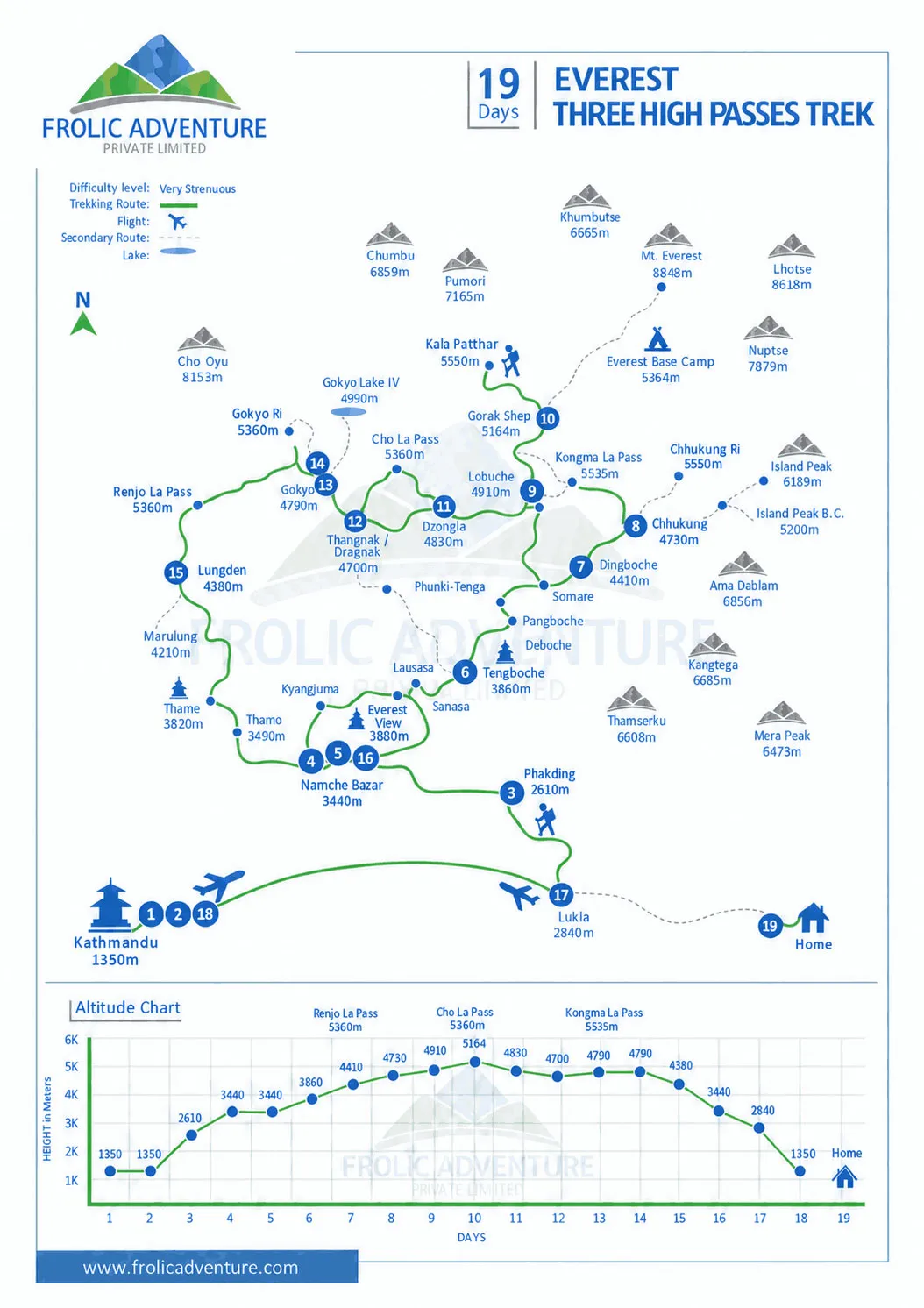
Route Map & Altitude Chart
Everest Three High Pass Trek
Trip Cost Details
- Airport pick-up and drop-off by private car/van/bus.
- 3 nights' accommodation at a 3-star hotel, including breakfast as per the above itinerary, on a twin-sharing basis.
- All ground and air transportation during the trip.
- Your standard meal BLD during the trek, with a cup of hot tea/coffee for breakfast
- All necessary paperwork, national park entry permits, Pasang Lhamu entry fees, and monument entrance fees
- All accommodations in lodges/tea houses during the treks.
- An experienced, helpful, and friendly guide and porter (one for two trekkers)
- Salary, food, drinks, accommodation, transportation, and insurance for the guide and porter.
- Your travel insurance company will pay for the arrangement of an emergency helicopter service.
- Certificate of achievement
- Frolic Adventure invites you to a farewell dinner last night.
- All government taxes (GST) and Stationery expenses.
Private Trip
Essential Information
The Best Time to Trek to Everest's High Passes
September to November in the autumn and March to May in the spring are the best times to trek to Nepal's Everest High Passes and the Himalayas. The autumn months offer the brightest mountain views and untouched nature, as monsoon rain clears all haze and makes the environment fresh.
Autumn temperatures are bearable, but later in November they get colder because winter starts soon after December. There is a lower chance of a flight cancellation to Lukla when starting the Trek in the autumn. Similarly, spring is also a perfect time for the Everest Three Passes Trek. Spring is the king of the seasons, so you can see nicely blooming flowers in the mountain region. There are hundreds of Everest climbers in spring, so you will have an excellent opportunity to meet them at the base camp and on the trekking trail. But there might be some snowfall on some days in the spring in the Himalayas.
Accommodation, Food, and Drink on the Everest High Pass Trail
There are plenty of lodges along the Everest High Passes route, which is why it is known as the Everest High Passes Lodge Trek. You will have a twin-sharing room in the guesthouse with comfortable, clean beds. You will get one blanket and a pillow on each bed. The Accommodations on the Trek are essential, but you can also stay in luxury lodges in the lower areas if you would like. Those luxury lodges are more expensive than regular ones.
Each lodge has a food menu with many varieties of food. You do not have to stick to local foods during the Trek, but you can also have local food items on the menu if you want to try them. You can buy mineral water bottles everywhere, but the price increases as you go to higher elevations. You can drink regular tap water, but purification methods are mandatory.
Toilets and Showers on the Trek
You have indoor toilets in the lodges where you stay on the trek. You even have attached toilets in your room in some places, but not everywhere. There are sitting and squatting toilets in the guesthouses. You might not get sitting ones at higher altitudes because of the cold temperatures. If the toilets freeze, they may smell and be unclear. That’s why the lodges do not use toilets in the higher areas.
You get proper hot showers using gas and electric heating on the trek, but you might need a hot bucket somewhere. If the running water gets frozen, you won’t have a proper hot shower, so you must use a hot bucket. You must pay for a hot shower on the trek.
Internet, communication, and battery charging during the Everest Three Passes
There is cell phone reception in most places on this trek, so you can buy a Nepalese SIM Card in Kathmandu before heading on to the Trek. You can also purchase internet data from these SIM Cards and use internet services in the mountains. NCELL and NTC are the service providers for this region.
Alternatively, you can buy the internet top-up card from Everest Link. You won’t have phone reception on the Gokyo side, so the Everest Link Card is the best option there.
Stay Safe on the trek.
Trekking in the mountains is not always safe. There might be some risk, too. You encounter many people, porters, yaks, Jokpe, and mules with loads on the trail. The load might shift if you meet them in narrow surroundings, so stay safe.
Domestic and wild animals move higher up the trekking trail. Stones might fall from their activity and hit you, so always watch your step while walking and do not stand directly in front of them.
The High Pass trail has ice and small stones that may make it slippery. Be careful while walking on those surfaces. The melting ice and wind on the High Pass trails might cause rocks to fall, so cross those risky areas before the intense sun, heat, and wind set in early in the morning.
Need Help? Call Us+977 9851043624