Book Now

Annapurna Base Camp Trek

146 reviews in TripAdvisor
44 reviews in Google

14-day Annapurna Base Camp (ABC) Trek with actual 9 days walk and drive out to Pokhara, 2 days Kathmandu-Pokhara-Kathmandu travel, 1 day for Kathmandu heritage cultural tour, and 2 days for arrival and departure is one of the best treks in Nepal, that takes macimum elevation 4,130 meters (13,549 feet), ABC at the botom of Mt. Annapurna South and Annapurna I and offers magnificent 360 degrees mountain views from the starting price 975-1,099 USD per person depending on the number of trekkers in a group that includes 3 nights accommodation in 3 star hotel with breakfast, 2 nights in Pokhara, all meal and guesthouse accommodation in the mountains, trek permits, tourist bus and private transport to trekking starting point and from trekking ending point, and experienced trek guide.

Trip Facts
Duration
14 Days
Trip Grade
Moderate
Country
Nepal
Maximum Altitude
4,130 meters
Starts
Kathmandu
Ends
Kathmandu
Group Size
1-10
Activities
Cultural Tour and Trek
Best Time
September to May

A Quick Glimpse

  • Trip Duration: 14 Days
  • Trekking Duration: 8 Days
  • Starting Point: Kathmandu
  • Ending Point: Kathmandu
  • Maximum Elevation: 4,130 meters / 13,549 feet
  • Difficulty Level: Moderate
  • Best Seasons: September to May
  • Key Highlights: Gurung and Magar culture, Traditional Villages with Gurung Architecture, rice fields, Waterfalls, Rivers, Blooming Flowers like Rhododendron and Himalayan Cherry, Sunrise and Sunset Views from Poon Hill, Annapurna Base Camp, and Chhomrong, Green Forests
  • Mountain Views: Annapurna I, Dhaulagiri, Annapurna South, Annapurna Fang, Fishtail (Machhapuchhre), Nilgiri, and more
  • Customizable: Yes

The Annapurna Base Camp (ABC) Trek is a moderate-level mountain trek in Nepal and the easiest base camp trip among high-mountain base camps. It is located in the Annapurna Region, west of Kathmandu and near Nepal’s second-largest city, Pokhara.

The Base Camp at 4,130 meters (13,549 feet) above sea level offers 360-degree views of the Annapurna Mountains at close range. The color of the mountains at sunrise and sunset is captivating.

The 9-day actual trekking to Annapurna Base Camp from Pokhara to Pokhara, including 5 more days from arrival in Nepal to departure, includes one day in Kathmandu for a tour, 2 days of Kathmandu- Pokhara- Kathmandu travel, and the final departure home.

I recommend trekking from October to December and March to May; however, most companies recommend September too, but it rains a lot due to climate change (You do not find authentic evidence in any trusted sites like Wikipedia, but I am sharing my experience, which I have been experiencing for a few years). November and December offer the most pleasant weather, so you can enjoy crystal-clear mountain views from morning to evening. But the temperature will be cold. I suggest wearing warmer clothes.

Namaste! I am Rajesh Thapaliya, operating trekking and tour services in Nepal, including Annapurna Base Camp treks, and I trek every year, so I am up to date with the region. I am sharing my personal experience to provide authentic, up-to-date information about the trek conditions for people who are planning to go there.

I started trekking to the ABC and other mountain regions in 2000 and have experienced lots of changes due to climate change and road construction. This trip used to take 10-15 days, but now it can be completed in 8-9 days thanks to improved road infrastructure to higher elevations.

What is the Best Time of Year to Trek to Annapurna Base Camp?

Autumn (September-November) and spring (March-May) are considered the best times to trek to Annapurna Base Camp; however, as I already mentioned above, September has lots of rain, and late May can be rainy in the lower region and bring soft hail at higher elevations. The views might not be clear if it rains, snows, or drops soft hail.

So far, I strongly recommend visiting the Annapurna Base Camp from October to December and from March to the first half of May. January and February are also doable with extra warm clothing because it snows less compared to a decade ago due to climate change.

Check some major differences between spring and autumn below:

Autumn Vs Spring
Spring Autumn
  • Blooming colorful rhododendrons
  • Less green with new leaves on the trees
  • Small waterfalls due to almost no rain
  • Difficult to see mountains from a far distance
  • Dry and less blue skies
  • Warm temperatures
  • Blooming Himalayan Cherry in November
  • Dark green forests
  • Big waterfalls after lots of monsoon rain
  • Mountains are visible at long distances, even from the city
  • Bright and clear blue sky
  • Cold Temperatures

After some quick information about spring and autumn above, I am going to provide detailed information about these two different seasons below:

Pre-Monsoon Season (March to May)

Spring comes before the monsoon, Nepal's driest season. It begins in March and ends in May. It is a dry and warm season, but it brings the most beautiful nature, with colorful flowers blooming in the forests.

If you do not like super cold temperatures, spring can be the best time to trek to the Annapurna Base Camp. You do not have to pack super warm clothes for April and May; however, March is still cold.

Because of dryness and almost no rain, the environment will be hazy from dust and smoke, and you won’t be able to see mountain views from a long distance. Rivers and Waterfalls are small during this dry time along the way.

Post-Monsoon Season (September-November)

It rains a lot in Nepal from June to August; then autumn comes. September marks the start of autumn; it still rains a lot for a few years because of the changing climate. This season offers the finest weather with dark greenery, blue skies, and bright mountain views even from a far distance.

The waterfalls will be roaring, and the Himalayan cherry flowers will be blooming along the Annapurna Base Camp route. The temperature will be colder, especially in November, than in September and October.

The trekking trail will be crowded in autumn. It is the festival season in Nepal, so many domestic trekkers will be walking this trail during their holidays. The guesthouses are often full, so people who trek without a guide in autumn may struggle to find a place to sleep.

Winter Season (December to February)

Not many people trek in winter because of the cold. However, December offers the best views from morning to evening. December is the first month of winter, which is why I did not keep it in the autumn section. Trekking in a quieter environment and with the finest views, December is the best month of the year. However, you must pack warmer clothing than in other months.

There are trekkers on this route in January and February too, but it may be snowing a lot some days and be risky.

How Much Does the Annapurna Base Camp Trip Cost?

It costs 1099 USD for a single trekker and covers from arrival in Nepal to departure on a full-board basis. The price covers international airport transportation, tourist coach transportation between Kathmandu and Pokhara, private transport to the trekking starting point, and after the trek, all necessary paperwork including the Annapurna Conservation Area (ACA) permit, guide, three nights hotel accommodation with breakfast in Kathmandu, two nights hotel accommodation with breakfast in Kathmandu, and all meals and guesthouse accommodation in the mountains.

Still, the cost for the Annapurna Base Camp depends on the hotel category in the cities and other requested services. It also differs by group size. A family, couple, or friends who book the trip at the same time can get special offers and discounts.

  • 1 Trekker – 1099 USD
  • 2-4 Trekkers – 1025 USD per person
  • 5-10 Trekkers – 975 USD per person

Breakdown of Cost for the Trek

Transportation Cost

  • Kathmandu-Pokhara Tourist Bus: 10 USD
  • Kathmandu-Pokhara Flight: 100 USD
  • Kathmandu-Pokhara Public Bus:9 USD
  • Kathmandu-Pokhara Private Car: 150 USD
  • Pokhara-Birethanti Private Car: 25 USD
  • Pokhara-Banthanti Jeep: 70 USD
  • Samrung-Pokhara Private Jeep (after the trek): 70 USD

Food Cost

  • 10-15 USD per meal

Drinks, Hot Shower, and Battery Charging Cost

  • 10-15 USD per day

Accommodation Cost

  • 5 USD per night

Permit Cost

  • Annapurna Conservation Area (ACA): 3000 NPR

Guide Cost

  • 25 USD per day

Porter Cost

  • 18 USD per day

In addition, extra drinks, shopping, and tipping the guide and porter are extra expenses.

What Permits are Required to trek Annapurna Base Camp?

The Annapurna Conservation Area (ACA) entry permit is the only permit required for this trek. Trekkers must have a Trekker’s Information Management System (TIMS) permit, but it is not required at present; the next regulation will be announced by the Nepal Tourism Board (NTB).

Free Individual Trekkers (FIT) can also obtain the ACA permit from the National Trust for Nature Conservation (NTNC) offices in Brikutimandap, Kathmandu, and Pokhara, at the counter or online via the website. For the counter request, trekkers must have a physical passport-size photo, and for the online application, they can upload a digital photo with details from the applicant’s passport.

It costs 3000 NPR for all trekkers except for the South Asian trekkers from India, Pakistan, Sri Lanka, Maldives, Bhutan, and Bangladesh. It costs 1000 NPR for them, and no permit is required for Nepali domestic trekkers, guides, and porters.

Outline Itinerary of the Trek

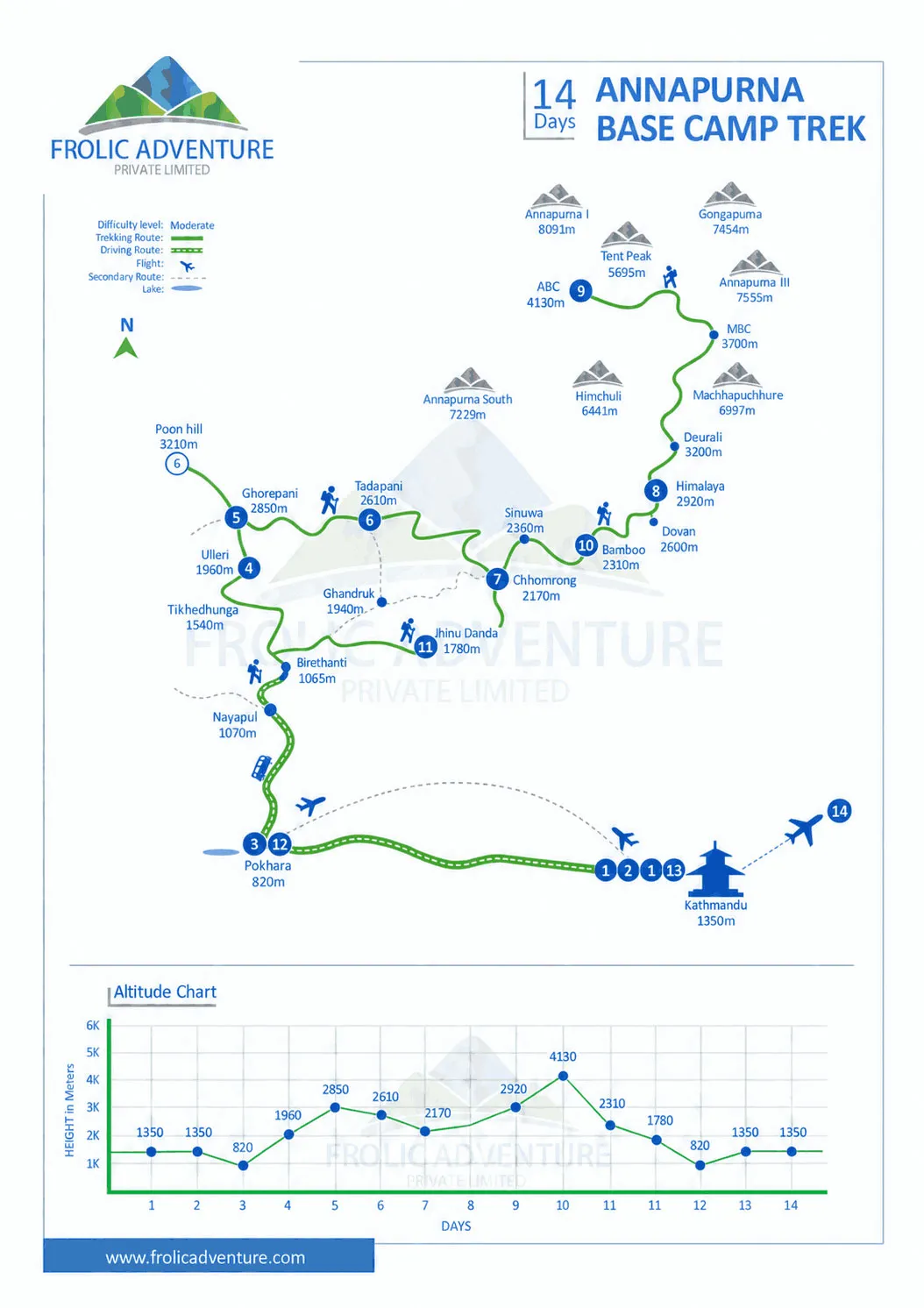
I have set up a 14-day trip Itinerary from arrival in Nepal to departure, including a 9-day walk in the mountains from Pokhara to Pokhara. According to the itinerary I have set up for this package, we pick our client from the Tribhuvan International Airport (TIA) in Kathmandu, trip meet and Kathmandu day tour on the second day, drive to Pokhara (flight optional available), on the third day, drive to Birethanti and trek to Ulleri on the fourth day, trek to Ghorepani on the fifth day, hike to Poon Hill and trek to Tadapani on the sixth day, trek to Chhomrong on the seventh day, trek to Himalaya Hotel on the eighth day, trek to Annapurna Base Camp (ABC) on the nineth day, then return the same way to Bamboo on the tenth day, trek to Jhinu Danda on the eleventh day, drive from Samrung to Pokhara on the twelveth day, drive back to Kathmandu on the thirteenth day, and departure to the airport for the client’s final flight to home.

Here is the day-to-day itinerary for the Annapurna Base Camp trek, with altitudes and walking times below, for your ease of understanding.

  1. Arrive in Kathmandu, 1,350 meters  (4,429 feet)
  2. Full-day Kathmandu City Tour.
  3. Drive to Pokhara, Lake City 8,20 meters  (2,690 feet). 6- 7 hrs.
  4. Drive from Pokhara to Birethanti for 2 hrs, then trek to Ulleri, 2,050 meters (6,725 feet). 5 hrs.
  5. Trek from Ulleri to Ghorepani, 2,850 meters (9,350 feet), for 5- 6 hrs.
  6. Hike up to Poon Hill, 3,210 meters (10,531 feet), and trek to Tadapani, 2,610 meters (8,562 feet). 5 hrs.
  7. Trek from Tadapani to Chhomrong, 2,170 meters (7,119 feet). 5 hrs.
  8. Trek from Chhomrong to Himalaya, 2,900 meters (9,514 feet). 7 hrs.
  9. Trek from Himalaya to Annapurna Base Camp, 4,130 meters (13,549 feet). 6 hrs
  10. Trek back from Annapurna Base Camp to Bamboo, 2,310 meters (7,578 feet). 5-6 hrs.
  11. Trek from Bamboo to Jhinu Danda 1,780 meters (5,839 feet) 5 hrs.
  12. Drive from Samrung to Pokhara 8,20 meters (2,690 feet), 4 hrs.
  13. Drive back to Kathmandu—farewell dinner with Frolic Adventure.
  14. Departure for the international airport

For day-to-day details on the itinerary mentioned, please visit the main itinerary section and click the expand button.

Annapurna Base Camp (ABC) Vs Everest Base Camp (EBC) Trek

It depends on your time limit, budget, physical fitness, and experience with high altitudes when choosing between Annapurna Base Camp (ABC) and Everest Base Camp (EBC) treks. The ABC is a shorter, lower-altitude trek (4,130 meters/13,549.87 feet), low-budget, and more affordable for everyone, including beginners with some hiking experience. On the other hand, Everest Base Camp (EBC) is longer, at a higher elevation (5,364 meters / 17,598.43 feet), and the ground transportation connection to the trek is not easy; flights to Lukla are often canceled, and domestic airline fares are high. However, it is a rewarding trek for experienced high-altitude trekkers, offering hundreds of high-mountain views, including the world’s highest peak.

Annapurna Base Camp Vs Everest Base Camp
Feature ABC EBC
Max Altitude 4,130m (13,549 ft)

5,364m (17,598 ft)

Trek Duration 8-14 days

10-15 days

Average Cost 700 – 1099 USD 1000 – 1350 USD

Difficulty

Moderate (Steep stairs) Challenging (High altitude)
Starting Point Pokhara (Road access) Lukla (Flight required)
Landscape Forests, terraced fields, sanctuary Glacial moraines, alpine desert

Choose the ABC Trek under these conditions:

If you are a beginner, the lower altitude carries a very low risk of Acute Mountain Sickness (AMS). If you are not familiar with high altitudes, the ABC is perfect for you; you can try the EBC once you have acclimatized to the ABC.

If you have limited time, it is a shorter trek with easy access to transport to the city. If you have limited time, Annapurna Base Camp is the best option because you can complete your trek on time and won't have to worry about missing your international flight.

Low-budget trek: If you are looking for a low-budget mountain trek that takes you close to the high mountains, the ABC trek can be done on a low budget and takes you very close to the high mountains within a few days’ walk from the city.

Choose the EBC Trek under these conditions:

If you are a regular hiker, have high-altitude experience, and have a big wish to stand at the bottom of the world’s highest mountain: The EBC is at high altitude (5,364m (17,598 ft) and you must have prior high-elevation experience to experience stepping at the bottom of the world’s highest mountain.

If you want to explore high-alpine scenery and a greater number of mountains, the EBC trek is better if you like high-mountain glaciers, high-alpine atmosphere, high-Himalayan settlements, and the lifestyle.

If you love to see Sherpa culture and experience their hospitality: Sherpas are the local inhabitants of the Khumbu Everest Region. They are well-known as great mountain climbers. The EBC trek is perfect for you if you are curious about their culture, lifestyle, daily activities, and want to experience their hospitality.

Annapurna Base Camp (ABC) Vs Annapurna Circuit Trek (ACT)

Accordingly, you might also be interested in the differences between Annapurna Base Camp (ABC) and the Annapurna Circuit Trek (ACT). Both treks are in the same mountain region and require a similar ACA permit, obtained from the National Trust for Nature Conservation (NTNC). However, there are vast differences between these two treks, even though they are in the same mountain region.

It depends on your time limit, budget, physical fitness, and experience with high altitudes when choosing between Annapurna Base Camp (ABC) and Annapurna Circuit Trek (ACT). The ABC is shorter, at a lower altitude (4,130 meters / 13,549.87 feet), low-budget, and more affordable for everyone, including beginners with some hiking experience. On the other hand, the Annapurna Circuit Trek (ACT) is longer, at higher elevations, includes a crossing of the Thorong La Pass (5,416 meters / 17,769.03 feet), and costs more due to its longer duration. However, it is a highly rewarding trek for physically fit, acclimatized trekkers who want to experience dramatically changing climate zones and cross one of the world's highest trekking passes.

Annapurna Base Camp Vs Annapurna Circuit
Feature ABC ACT
Max Altitude 4,130m (13,549 ft)

5,416m (17,769 ft)

Trek Duration 8-14 days 9-16 days
Average Cost 700 – 1099 USD 750 – 1150 USD
Difficulty Moderate (Steep stairs) Challenging (High altitude pass)
Starting Point Pokhara (Road access) Besisahar (Road access)
Landscape Forests, terraced fields, sanctuary Diverse, from subtropical jungles to alpine desert

Choose the ABC Trek under these conditions:

If you are a beginner or have limited time, the lower altitude carries a very low risk of Acute Mountain Sickness (AMS), and it is a shorter trek with easy access to transport from Pokhara. If you are not familiar with high altitudes or only have a week to spare, the ABC is perfect for you to complete on time without missing your schedule.

If you want to be surrounded by close-up peaks, the trek takes you straight into the Annapurna Sanctuary, placing you in a massive glacial basin surrounded by a 360-degree amphitheater of towering, close-up mountain walls.

If you are looking for a low-budget mountain trek that takes you close to the high mountains, the ABC trek is a good option. With simple overland transport and fewer trekking days, it can be done on a low budget and brings you very close to the high mountains within a few days' walk from the city.

Choose the ACT Trek under these conditions:

If you are a regular hiker with great stamina and a strong desire to cross a massive mountain pass, the ACT requires you to cross the Thorong La Pass at 5,416m (17,769 ft). You must have excellent fitness and properly acclimatize to step over this high-elevation milestone.

If you want to explore drastically changing landscapes: The ACT is better if you like to explore an incredible variety of scenery, walking from lush green subtropical jungles and deep river gorges up into the dry, high-alpine desert atmosphere in the rain shadow of the Himalayas.

If you love to see diverse cultures and experience ancient mountain traditions: The ACT trek takes you through a massive shift in local demographics. It is perfect for you if you are curious to experience the transition from Hindu villages in the lower foothills to deeply rooted Tibetan Buddhist communities, ancient monasteries, and the distinct highland lifestyle of Manang and Mustang.

Annapurna Base Camp Trek Booking with Frolic Adventure

Frolic Adventure offers trekking trips to Annapurna Base Camp with experienced, English-speaking guides authorized by the Nepal Government and the Nepal Tourism Board (NTB). The guides are well-trained in altitude sickness management and knowledgeable about Nepal, the mountain regions, and the Annapurna Base Camp route.

Our goal is to provide memorable trips at a very reasonable cost, with safety and satisfaction for our clients. We offer easy online booking with secure payment options. So, book your trek now with a 10% advance deposit and pay the rest later to save your seat.


Annapurna Base Camp Trek Itinerary

Starts
Kathmandu
Ends
Kathmandu
Day 1

Arrive in Kathmandu (1,350 m / 4,429 feet.)

Kathmandu Airport Terminal

At Tribhuvan International Airport, Frolic Adventure's representative will be on standby to meet us. From there, we will drive directly to our hotel. After well-deserved refreshments, we will meet the company tour manager, who will brief us on the trek. Overnight stay at a hotel in Kathmandu.

Max Altitude: 1,350m (4,429ft)
Accommodation: 3 Star Hotel
Mode of Transportation: Private Car/Jeep/Van
Day 2

Trip Meeting and Trek Preparation Day (Optional, Kathmandu Cultural Heritage Tour)

Cultural Monuments of Kathmandu

Today we have a short meeting with Frolic Adventure's manager to prepare the trek. You can also visit Kathmandu's four UNESCO World Heritage Sites, which is highly suggested, where you can learn ancient Nepalese history, culture, religion, art, architecture, and more from our expert tour guide and see beautiful cultural monuments. Overnight in the hotel.

Max Altitude: 1,350m (4,429ft)
Meals: Breakfast
Accommodation: 3 Star Hotel
Day 3

Drive to Pokhara, Lake City. (8,20 m / 2,690 feet.) 6-7hrs.

Mountain Views from Pokhara

Today, we drive from Kathmandu to Pokhara in the morning. It usually takes 6-7 hours, but it may take longer, around 10 hours, because of road construction. We pass many typical villages, driving through different valleys and seeing farming lands, waterfalls, rivers, green hills, and more. After we arrive in Pokhara, we check into the hotel and walk around Fewa Lake in the evening. Overnight in the Hotel.

Max Altitude: 820m (2,690ft)
Duration: 530
Duration: 6-7 Hours
Distance: 200 KM
Meals: Breakfast
Accommodation: 3 Star Hotel
Mode of Transportation: Tourist Bus
Day 4

Drive from Pokhara to Birethanti for 2 hrs and trek to Ulleri (2,050 m / 6,725 feet) 5-6 hrs

Ulleri Village

Today, we begin our trek to ABC from Birethanti, a two-hour drive from Pokhara. Trekking along the banks of the Bhurungdi River, we reach the bustling hamlet of Tikhedhunga, where we stop for lunch. After lunch, we must ascend the trail for two hours to Ulleri, where we will spend the night.

Max Altitude: 2,050m (6,725ft)
Altitude Gain: 1230
Duration: 5-6 Hours
Distance: 10-11 KM
Meals: Breakfast+Lunch+Dinner
Accommodation: Guesthouse
Mode of Transportation: Private Car/Van/Bus
Day 5

Trek from Ulleri to Ghorepani (2,850 m / 9,350 feet.) 5-6 hrs.

Poon Hill

The journey heads towards the scenic Ghorepani today, marking the start of the long days of travel. The trail leads out of Ulleri to Banthanti on a gradual ascending trail for an hour. Then, we continue our journey through patches of lush green forests filled with oak and rhododendron trees to reach Nangethanti. The trail continues to Ghorepani, surrounded by forested lands and mesmerizing landscapes. Overnight stay at Ghorepani.

Max Altitude: 2,850m (9,350ft)
Altitude Gain: 800
Duration: 5-6 Hours
Distance: 8-10 KM
Meals: Breakfast+Lunch+Dinner
Accommodation: Guesthouse
Mode of Transportation: Walk
Day 6

Hike up to Poon Hill (3,210m.) and trek to Tadapani (2,630 m / 8,628 feet.) 5-6 hrs.

Mountain Views from Tadapani

An early day as we make our way up to the scenic viewpoint of Poon Hill to witness the mesmerizing views of the Himalayan sunrise. The sights of Manaslu (8,163 m), Gangapurna (7,454 m), the fish-tailed Machhapuchhre (6,997 m), and Lamjung Himal (6,983 m), accompanied by countless other Himalayas from the Great Annapurna Range, are sights you don't come across often. We then descend to Ghorepani for breakfast, and continue our journey to Tadapani along its ridges and through alpine forests. Overnight stay at Tadapani.

Max Altitude: 2,630m (8,628ft)
Altitude Gain: 360
Duration: 580
Duration: 5-6 Hours
Distance: 8-11 KM
Meals: Breakfast+Lunch+Dinner
Accommodation: Guesthouse
Mode of Transportation: Walk
Day 7

Trek from Tadapani to Chhomrong (2,170 m / 7,119 feet.) 5-6 hrs.

Tea Garden in Chhomrong

One of the shorter days of the Annapurna Base Camp trek as we travel to Chhomrong. The journey begins with a downhill trek through lush green forests, alive with wildlife, to reach Gurjung Village, adorned by the culturally rich ethnic Gurung tribe. The trail stretches through alpine forests and Nepali flatlands, punctuated by short ascents and descents, before ending at Chhomrong. Overnight stay at Chhomrong.

Max Altitude: 2,170m (7,119ft)
Duration: 460
Duration: 5-6 Hours
Distance: 8-10 KM
Meals: Breakfast+Lunch+Dinner
Accommodation: Guesthouse
Mode of Transportation: Walk
Day 8

Trek from Chhomrong to Himalaya (2,900 m / 9,514 feet.) 7-8 hrs.

Teahouse in Himalaya

The trail heading out of Chhomrong descends through the stone staircase to reach Chhomrong Khola. It crosses it on a suspension bridge leading toward the lush green forests of Bamboo and oak trees. The journey continues with another ascent, heading towards Kuldighar at the top of the hill, before descending through familiar forests of oak and rhododendron to reach Bamboo. After Bamboo, we walk to Dovan and the Himalayas through Bamboo, oak, and pine forests and overnight in the Himalaya Hotel.

Max Altitude: 2,900m (9,514ft)
Altitude Gain: 730
Duration: 7-8 Hours
Distance: 12-13 KM
Meals: Breakfast+Lunch+Dinner
Accommodation: Guesthouse
Mode of Transportation: Walk
Day 9

Trek from Himalaya to Annapurna Base Camp (4,130 m / 13,549 feet.) 6-7 hrs

Annapurna I View from ABC

Today, we head towards the Annapurna Base Camp at 4,130 m after passing Machhapuchhre Base Camp. The trail leads past the mesmerizingly captivating views of Machhapuchhre (6,997 m), Annapurna I (8,091 m), Annapurna South (7,219 m), Gangapurna (7,454 m), Annapurna Fang (7,646 m), Hiunchuli (6,441 m), Annapurna III (7,555 m), and sky-high peaks of the Annapurna Region. We spend the night at the base camp enjoying the stunning views of a Himalayan sunset. Overnight stay at Annapurna Base Camp.

Max Altitude: 4,130m (13,549ft)
Altitude Gain: 1230
Duration: 6-7 Hours
Distance: 9-10 KM
Meals: Breakfast+Lunch+Dinner
Accommodation: Guesthouse
Mode of Transportation: Walk
Day 10

Trek back from Annapurna Base Camp to Bamboo (2,310 m / 7,578 feet.) 5-6 hrs.

Bamboo

Today, we begin the downhill journey away from the Himalayan canopy. The trip descends quickly along the rugged Himalayan trail, reaching the ever-growing forests filled with Bamboo, oak, and rhododendron trees. Amid stunning landscapes and small settlements, we continue our journey, reaching the village of Bamboo. Overnight stay at Bamboo.

Max Altitude: 2,310m (7,578ft)
Duration: 1820
Duration: 5-6 Hours
Distance: 12-15 KM
Meals: Breakfast+Lunch+Dinner
Accommodation: Guesthouse
Mode of Transportation: Walk
Day 11

Trek from Bamboo to Jhinu Danda (1,780 m / 5,839 feet.) 5-6 hrs.

Hotspring in Jhinu

Today, we visit Jhinu Danda, our final Himalayan settlement before Pokhara. The journey out of Bamboo rises alongside the hill, reaching Kuldighar at the top. Beyond that, the downhill forest trail leads to Chhomrong Khola. Continuing down the path, we reach Jhinu Danda, followed by a tranquil bath in the hot water springs—the perfect place to drown our aches after the mesmerizing journey through the Himalayas. Overnight stay at Jhinu Danda.

Max Altitude: 1,780m (5,839ft)
Duration: 530
Duration: 5-6 Hours
Distance: 9-11 KM
Meals: Breakfast+Lunch+Dinner
Accommodation: Guesthouse
Mode of Transportation: Walk
Day 12

Drive from Samrung to Pokhara (8,20 m / 2,690 feet) 4 hrs.

Annapurna Himalayas from Pokhara

On today's final day of the Annapurna Base Camp Trek, we drive through typical villages and farming land from Samrung to Pokhara on a hillside road. It takes around four hours to reach Pokhara. After checking into the hotel, we can walk around the lakeside and celebrate the trek's success. We will stay overnight at a hotel in Pokhara.

Max Altitude: 820m (2,690ft)
Duration: 960
Duration: 4 Hours
Distance: 40-65 KM
Meals: Breakfast
Accommodation: 3 Star Hotel
Mode of Transportation: Private Jeep
Day 13

Drive back to Kathmandu—farewell dinner with Frolic Adventure.

Pagoda Temple in Kathmandu

On the final day of the journey, we head back to Kathmandu, leaving Pokhara via the tight bends of the Prithvi Highway. Soon, the thrashing Trishuli River joins us, crowded with rafters seeking adventure and thrill in her rocky curves. Once back in Kathmandu, we will head back to our hotel and enjoy the amenities before the farewell dinner with Frolic Adventure. Overnight stay at a hotel in Kathmandu.

Max Altitude: 1,350m (4,429ft)
Altitude Gain: 530
Duration: 6-7 Hours
Distance: 200 KM
Meals: Breakfast+Dinner
Accommodation: 3 Star Hotel
Mode of Transportation: Tourist Bus
Day 14

Departure to the international airport

Frolic Adventure's representative will drop us back at Tribhuvan International Airport again with the team's best wishes.

Mode of Transportation: Private Car/Van/Bus

This ten-day Annapurna Base Camp trek itinerary is the usual itinerary. We can also make a customized Annapurna Base Camp trek itinerary. We also provide:

The Annapurna Base Camp Mardi Himal trek itinerary.

Two-week Annapurna Base Camp trek itinerary.

The one-week Annapurna Base Camp trek itinerary is of interest to you.

Are you still confuse from where to start?
No worries - Our team is ready to guide you!

Route Map & Altitude Chart

Annapurna Base Camp Trek

Trip Cost Details

  • Airport pick-up and drop-off by private car/van/bus.
  • 3 nights' Accommodation in Kathmandu in a 3-star hotel, including breakfast as per the above itinerary, on a twin-sharing basis.
  • 2 nights' accommodation in Pokhara in a 3-star hotel, including breakfast as per the above itinerary on a twin-sharing basis.
  • All the ground transportation during the trip.
  • Your standard meal BLD during the trek, with a cup of hot tea/coffee for breakfast
  • Fresh fruit after every dinner in the mountains
  • All necessary paperwork, conservation area entry permits, and TIMS Cards.
  • All accommodations in lodges/tea houses during the treks.
  • An experienced, helpful, and friendly guide and porter (one for two trekkers)
  • Salary, food, drinks, accommodation, transportation, and insurance for the guide and porter.
  • Your travel insurance company will pay for the arrangement of an emergency helicopter service.
  • Certificate of achievement
  • Frolic Adventure invites you to a farewell dinner last night.
  • All government taxes (GST) and Stationery expenses.

Private Trip

Equipment List

Annapurna Base Camp takes you close to the high mountains and can be freezing, especially from October to February, so you need high-quality, warm trekking gear. However, spring requires less warm clothing than autumn and winter. Also, the most important thing to pack is sleeping gear with earplugs because you may share dorm beds with strangers for a few nights due to limited accommodation for the number of trekkers at the same time. People in your room might snore, so bring gear to help you sleep well.

Upper Body Layers
  • 1 Thermal top (synthetic or merino wool)
  • 2 synthetic or merino trekking shirts (at least one with half sleeves)
  • 1 fleece, thin down, or windproof jacket for insulation or wear while resting
  • 1 heavy down jacket (you can hire in Kathmandu or Pokhara if you do not have)
  • Waterproof top in case of rain or wind
  • Winter gloves
  • thin gloves (screen touchable)
Lower Body Layers
  • 1 thermel bottoms
  • 2-3 pairs of breathable underwear (you can wash them when you take a shower)
  • 2 trekking pants
  • 1 windproof trousers for rain and wind
  • 2 sports bras for female trekkers
  • Swimming gear for hot spring
Footwear & Accessories
  • Trekking Boots (well-gripped, ankle-supportive, and slightly loose in size)
  • Sneaker/Sport shoes and water sandals for the camp
  • 3-4 pairs of trekking socks (wool or synthetic)
  • Gaiters (in case of snow)
  • Micro spikes
Head & Sun Protection
  • Warm winter hat (Wool, synthetic, fleece, or Fur & Shearling)
  • Buff or neck gaiter
  • sun hat
  • UV-protective sunglasses
  • SPF 5o sun lotion
  • Lip Balm
Personal & Medical Kits
  • Personal medication (if you are regularly taking it as suggested by your doctor)
  • Diamox, Acetazolamide, or other altitude pills (not a medicine to cure altitude sickness! Best to descend according to the situation)
  • Painkillers like ibuprofen or paracetamol
  • Antiseptic cream
  • Blister kit
  • Rehydration salts
  • Imodium for diarrhea
  • Sticking Plaster
  • Vitamin C tablets
  • Water purification tablets
  • Bandages
  • Knee and ankle supporter
  • Thermopad or toe warmer
Travel Documents
  • At least 6 months valid passport
  • Annapurna Conservation Area (ACA) entry permit
  • Travel insurance that covers all medical and emmergency evacuation up to 5000 meters
Miscellaneous

Backpacks

  • Main duffel bag (60-80 L), which we provide for our clients and porters carry, or a rucksack.
  • Daypack to carry day essentials, warm clothes, and valuable items
  • Rain cover for main bag and daypack
  • Drybag or packing pouch to keep your equipment dry, safe, and easy to manage in space

Sleeping Gear

  • 4-season sleeping bag (rated to -10°C to -20°C / 14°F to -4°F)
  • Fleece Sleeping liner
  • Pillowcase or travel pillow
  • Earplugs (someone may snore in and near your room)

Toiletries and Hygiene

  • Quick-dry towel
  • Toothbrush/toothpaste
  • Shampoo and body shop
  • Baby wipes and hand sanitizers
  • Moisturising cream
  • Body spray
  • Toilet paper (not provided in guesthouses, and can be bought in Namche Bazaar)
  • Tissue paper (you might have a runny nose in cold and high altitudes)

Electronics

  • Headlamp with extra batteries (for early morning hikes and night use to go to the washroom)
  • Powerbank (10.000-20,000 mAh)
  • Charging cable
  • Universal travel adapter
  • Solar charger (optional, but minimizes charging cost in the mountains)

Other Essentials

  • Trekking poles (very supportive for up and down hills)
  • 2 water bottles or a Camelbak
  • Snacks and energy bars
  • Extra shoeless
  • Polyethylene bags (to put dirty and wet clothes)
  • Nepali currency (no ATMs besides Lukla and Namche Bazaar, and low exchange rate in the mountains)

Essential Information

Leaving Things That You Don’t Need for the Trek

If you are traveling in Nepal for a longer time and planning to trek to Annapurna Base Camp for a few days, and have lots of city wear and other things, including some valuables, and are worried about managing those things while you are in the mountains. You can leave them in the hotel in Pokhara and take them back after the trek. Each hotel has a safe storeroom, and they store your things safely.

Trekking Trail will be Crowded, and Teahouses Have Limited Accommodation

The trail is the same going and returning after Chomrong, so hundreds of trekkers will be on it, and it will be crowded. After Sinuwa, teahouses have limited rooms, and they fill up fast, so it can be hard to get a private place to sleep. Most rooms have dormitory beds and must be shared with others if you do not book in advance, during very busy times, and if you are traveling solo.

It is the Reason of the Brave Gurkhas

The local people are Gurung and Magar in this region, and many serve in the British and Indian Gurkha regiments. They are known as brave people and entertain with a cultural dancing and singing program called Rodhi. Locals who are living in the village, they mainly do farming and grow rice, wheat, corn, millet, and vegetables.

Do Not Bring Beef, Buffalo, Chicken, Pork, and other meats except goat (mutton)

The region is sacred and has strong beliefs, so do not bring prohibited items after Sinuwa. People believe those who bring restricted items will face difficulties, and it can also cause problems for the region and others. So, please be polite and respect the culture.

Price Per Person
US$975
  • 1 paxUS$1099
  • 2 - 4 paxUS$1025
  • 5 - 10 paxUS$975
Talk to Our Travel Experts
Rajesh Thapaliya
Nepal Travel Consultant
Rajesh Thapaliya
+977 9851043624
Santosh Thapa
Singapore Travel Consultant
Santosh Thapa
+65 90471348

Travel Moments

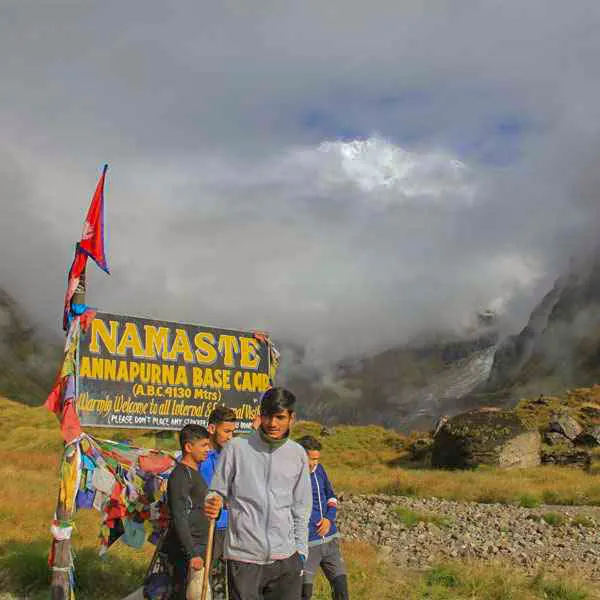
Trekkers at Annapurna Base Camp
Morning view from Annapurna Base Camp

What Our Clients Say

September 26, 2026
ANNAPURNA BASE CAMP

Thank you very much for your excellent guidance and support throughout our Annapurna Base Camp trek. Your experience, care, and encouragement made our journey safe and memorable. We truly appreciate all your efforts and wish...

V
Voleeth Ahamed
United Arab Emirates
Need Help? Call Us+977 9851043624
Annapurna Base Camp Trek Guide: Itinerary, Cost & Best Time