
17-day Mera Peak Climbing trip with an actual 1 day for the climb, 12 days of trekking, one day for flyout from Lukla, one spare day to manage the flight and climbing situation, one cultural heritage tour in Kathmandu, and 2 days for arrival and departure is an adventurous mountain trip in the Everest Region, but the trekking route and climbing are completely different than the regular Everest route. It costs 22150-2300 USD according to the number of climbers and trekkers in a group, which includes Lukla round-trip flights, trek and climb permits, all food and accommodation, including one night in a tent for the high camp, 3 nights of hotel accommodation in Kathmandu with breakfast, and a trek/tour/climb guide.
Mera Peak Climbing
Trip Facts
Duration
18 Days
Trip Grade
Technically Challenging
Country
Nepal
Maximum Altitude
6,461 meters
Starts
Kathmandu
Ends
Kathmandu
Group Size
1-10
Activities
Peak Climbing, Trekking, and Cultural Tour
Best Time
October to November and March to May
A Quick Glimpse
- Trip Duration: 17 Days
- Trekking plus Climbing Duration: 13 Days
- Starting Point: Kathmandu
- Ending Point: Kathmandu
- Maximum Elevation: 6,461 meters (21,197 feet)
- Difficulty Level: Technically Challenging
- Best Seasons: October to December and March to May
- Key Highlights: Mountain views, adventure climbing, scenic flight of Lukla, traditional villages with typical architectural buildings, cultural and religious monuments, wildlife, lush forests, and more
- Mountain Views: Everest, Lhotse, Cho-Oyu, Makalu, and more
- Customizable: Yes
Mera Peak climbing is one of Nepal's most sought-after mountaineering adventures, which offers a blend of physical challenge, technical climbing, and breathtaking Himalayan scenery. Mera Peak stands in the Khumbu region within Makalu Barun National Park, at an elevation of 6,476 m (21,247 feet). It is the highest trekking peak to climb in Nepal. If you are an adventure seeker and looking for a peak to climb in Nepal that requires less physical effort with some technical support, Mera Peak is ideal for you to test your limits while enjoying panoramic views of iconic peaks such as Everest, Lhotse, Makalu, Cho Oyu, and Kanchenjunga.
Short Information on Climbing Mera Peak
Mera Peak is classified as a trekking peak and graded as "Facile Easy" (F) according to the French/Swiss Alpine Climbing Classification System. While technically less demanding than other Himalayan peaks, the climb requires physical endurance, mental resilience, and basic mountaineering skills. You need to have knowledge of glacier travel, steep ascents, and the use of technical climbing equipment such as crampons, ice axes, ropes, and harnesses before starting a journey to Mera Peak.
The route to Mera Peak begins with a flight from Kathmandu or Manthali to Lukla, the gateway to the Everest region. You trek through picturesque Sherpa Villages, dense rhododendron forests, and rugged terrain before reaching the Mera Peak Base Camp after you begin your walking journey from Lukla. The ascent typically includes acclimatization days and culminates in a summit push from High Camp at 5,800 meters (19,029 feet). The Mera Peak rewards you with unparalleled views of the Himalayas and a profound sense of accomplishment.
Challenges and Preparation to Climb Mera Peak
There are some challenges while climbing Mera Peak that require recommended preparation:
Altitude Risks: Mera Peak stands at 6,476 meters above sea level, making altitude sickness a major concern for climbers. Some people may have symptoms such as headaches, nausea, dizziness, and shortness of breath above 3,500 meters. We suggest proper acclimatization to minimize the risk of altitude sickness during your Mera Peak climbing trip. You must follow a "climb high, sleep low" strategy and take rest days to allow your body to adapt to lower oxygen levels.
Weather Conditions: The weather at high altitudes is unpredictable and can include extreme cold (-20°C or lower), strong winds, and sudden storms. You must layer properly with thermal clothing and windproof outerwear to protect yourself in harsh conditions.
Physical Fitness: Climbing to Mera Peak requires excellent physical fitness. Long trekking days (5–7 hours) on steep terrain require stamina and strength for everyone. We suggest doing cardiovascular exercises like running or cycling, combined with strength training for the legs and core muscles, as pre-trip preparation at least a month before you go on this peak climbing in Nepal.
Technical Skills: While not overly technical, you must be familiar with using crampons, ice axes, ropes, and harnesses. Training in glacier travel and knot tying can be beneficial for Mera Peak Adventure. Our Sherpa climbing guide helps and trains you with pre-climb training sessions before heading to the last camp's summit.
Best Time to Climb Mera Peak
Spring (March- May) and autumn (September–November) are the best times to climb Mera Peak. However, the Spring months offer warmer temperatures than the autumn months. These periods offer stable weather conditions and clear skies, enhancing the visibility of the surrounding peaks. Also, winter climbs are possible but more challenging due to colder temperatures.
Permits Required for Mera Peak
You must have specific permits to attempt Mera Peak, which are listed below:
- Climbing Permit issued by the Nepal Mountaineering Association (NMA).
- Sagarmatha National Park entry permit.
- Local area permit for Makalu Barun National Park.
We arrange all required permits and legal papers before you depart for Mera Peak. You must provide us with a copy of your passport, travel insurance details, all emergency covers, information about whether you have climbed any other mountains, and a photograph of when you booked this climbing trip.
Cultural Experience from the Mera Region
The trek to Mera Peak offers more than just physical challenges; it provides an immersive cultural experience. You pass through traditional Sherpa villages where you can witness local customs and lifestyles. The Sherpa community's hospitality adds warmth to your journey on the Mera Peak route. Additionally, you often gain insights into Buddhist traditions by visiting Buddhist monasteries along the trail.
You will see many Mani Rocks, Mani Wheels, and Mani Walls with Stupas while walking towards Mera Peak. You love the mantras written on big rocks and walking clockwise, keeping these religious monuments to your right.
Safety Measures of Climbing Mera Peak
Your safety is paramount while trekking and climbing Mera Peak. How will you stay safe on the trip? Check them below:
- Our climbing and trekking guides monitor your health and assist in emergencies.
- Emergency evacuation plans should be in place.
- Hydration and proper nutrition are emphasized throughout the trek.
- You are advised to listen to your body and descend immediately if symptoms of altitude sickness worsen.
Cost for Mera Peak in 2026/2027
The cost of climbing Mera Peak in 2026/2027 varies widely depending on factors such as group size, season, itinerary, and the level of service provided. For a standard package that includes permits, accommodations, meals, domestic flights, guides, and porters, prices typically range from USD 2,050 to USD 3,000 per person. Frolic Adventure offers group packages starting at USD 2,000 for larger groups and up to USD 2,150 for individuals. Costs can be higher for private trips or with overseas operators, reaching up to USD 3,590 in some cases, so book with us for the best deals today and save your space for any time in 2026/2027.
Additional expenses for Mera Peak include climbing permits (ranging from USD 70 in winter to USD 250 in spring), equipment rentals or purchases, travel insurance, and personal costs such as tips or extra meals and drinks. Transportation costs, such as flights to Lukla (USD 500 round trip), also add to the budget. Ultimately, the total cost depends on the trek's duration, route selection, and whether you choose a budget-friendly or premium package.
Why Choose Mera Peak with Frolic Adventure
Mera Peak is considered an excellent choice for you. If you are new to mountaineering and seeking a stepping stone toward more technical climbs like Island Peak or Lobuche Peak and would like to have climbing experience earlier, Mera Peak should be one of the best options for you. Its relatively straightforward ascent and stunning Himalayan vistas make it a rewarding experience to challenge yourself while enjoying Nepal's natural beauty.
Frolic Adventure operates climbing trips to Mera Peak and other trekking peaks in Nepal. We offer the best and most affordable prices for peak climbing, with a focus on your safety and satisfaction throughout your mountain adventure.
Mera Peak Climbing Itinerary
Day 1
Arrive in Kathmandu (1,350 m.).
Our airport representative will pick you up from Tribhuvan International Airport in Kathmandu by private transport and transfer you to the Hotel. Overnight at the hotel.
Max Altitude: 1,350m (4,429ft)
Accommodation: 3 Star Hotel
Mode of Transportation: Private Car/Jeep/Van
Day 2
Trip Meeting and Trek/Climb Preparation Day (Optional, Kathmandu Cultural Heritage Tour)
Today, our manager will meet you for a short time to provide essential information about safety, gear, and other trip details, and you can prepare your equipment. After that short meet, you will be free for the whole day, so 5-6 hour's tour to UNESCO World Heritage Sites like Kathmandu Durbar Square (Hanuman Dhoka Ancient Royal Palace), Swayambhunath (Monkey Temple), Pashupatinath (Open Cremation Place), and Bouddhanath and learn about ancient Nepalese history, culture, religion, art, architecture, stories, and more including recent changes in politics, development, and progeress with our tour guide and stay overnight in the hotel.
Max Altitude: 1,350m (4,429ft)
Duration: 6-7 Hours
Meals: Breakfast
Accommodation: 3 Star Hotel
Mode of Transportation: Private Car/Jeep/Van
Day 3
Fly to Lukla (2,840 m.) and trek to Paiya (2,730 m.) 5-6 hrs.
You will fly early in the morning to Lukla, a 30-minute flight, and then trek to Paiya. You will descend to Surki and climb to Paiya on this day. You will walk on the forest trail, cross some suspension bridges, and see a white mountain along the route. Overnight at a guest house.
Max Altitude: 2,730m (8,956ft)
Altitude Gain: 1490
Altitude Loss: 110
Duration: 5-6 Hours
Distance: 8-9.9 KM
Meals: Breakfast+Lunch+Dinner
Accommodation: Guesthouse
Mode of Transportation: Domestic Flight+Private Car/Jeep/Van (Ramechhap Transport is Sharing)
Day 4
Trek from Paiya to Pangkongma (2,846 m.) 5-6 hrs.
You will descend for a while from here and reach a small bridge. From here, the trail will be a bit slippery. You will cross rhododendron and bamboo forests through the narrow mountain forest. Crossing the Kari-La pass, you will reach Pangkongma today. Overnight at a guest house.
Max Altitude: 2,846m (9,337ft)
Altitude Gain: 116
Duration: 5-6 Hours
Distance: 11-12 KM
Meals: Breakfast+Lunch+Dinner
Accommodation: Guesthouse
Mode of Transportation: Walk
Day 5
Trek from Pangkongma to Nashing Dingma (2,591m.) 4-5 hrs.
After trekking out of Pangkongma, you will cross the Pangkongma La pass. Then the trail ascends, walks on a steady path, passes a mani, and reaches Shibuche. You will have lunch here. Then continue the trek downhill before crossing a bridge over the Hinku Khola. You will pass through Gai Kharka, a grazing area, and then reach Nashing Dinga. Overnight at a guest house.
Max Altitude: 2,591m (8,500ft)
Altitude Loss: 255
Duration: 4-5 Hours
Distance: 7.2-11 KM
Meals: Breakfast+Lunch+Dinner
Accommodation: Guesthouse
Mode of Transportation: Walk
Day 6
Trek from Nashing Dingma to Chhatra Khola (2,800 m.) 7-8 hrs.
You will descend to Surki La pass, cross it, and continue walking downhill for a while. Then the trail begins ascending. The trail then passes through Phokte Village, Chalem Kharka, and Danda Kharka. We also pass through bamboo forests. After Danda Kharka, there is an uphill walk to Panch Pokhari; you will follow a zigzag path before reaching Chhatra Khola. Overnight at a guest house.
Max Altitude: 2,800m (9,186ft)
Altitude Gain: 209
Duration: 7-8 Hours
Distance: 11-13 KM
Meals: Breakfast+Lunch+Dinner
Accommodation: Guesthouse
Mode of Transportation: Walk
Day 7
Trek from Chhatra Khola to Kothe (3,691 m.) 6-7 hrs.
You will walk towards the north on the main trail to Mera Peak. After walking on a path next to the Majang Khola, the trail merges with another track that moves alongside the Hinku Khola. You will walk straight ahead towards Tashing Ongma, which has seasonal tea shops, and continue the trek and cross the bridge over the Sanu Khola before reaching Kothe. Overnight at a guest house.
Max Altitude: 3,691m (12,109ft)
Altitude Gain: 891
Duration: 6-7 Hours
Distance: 12-14 KM
Meals: Breakfast+Lunch+Dinner
Accommodation: Guesthouse
Mode of Transportation: Walk
Day 8
Trek from Kothe to Thaknak (4,358 m.) 4-5 hrs.
You will trek along the ridge of the Hinku Khola in the shadow of Mera Peak. You will have lunch at Gondishung, the summer herders' settlement on the west bank of the Hinku Drangka. Beyond Gondishung, you will pass a 200-year-old Lungsumgba Gompa, where you can find Mera Peak scripted in rock along with its route to reach Mera. A short walk takes you to Thaknak, a summer grazing area with primitive lodges and shops. Overnight at a guest house.
Max Altitude: 4,358m (14,297ft)
Altitude Gain: 667
Duration: 3-4 Hours
Distance: 8-14 KM
Meals: Breakfast+Lunch+Dinner
Accommodation: Guesthouse
Mode of Transportation: Walk
Day 9
Trek from Thaknak to Khare (5,045 m.) 4-5 hrs.
You will follow the lateral moraine of Dig Glacier to Dig Kharka, which offers spectacular views of Charpate Himal. The trail climbs through moraines to the snout of the Hinku Nup and Shar glaciers, then continues more steeply to Khare. From here, you can see the northern face of Mera Peak, which is a fantastic sight. After lunch, we can hike in and around Khare, and you will have a climbing practice here. Overnight at the guest house.
Max Altitude: 5,045m (16,551ft)
Altitude Gain: 687
Duration: 4-5 Hours
Distance: 4-5.6 KM
Meals: Breakfast+Lunch+Dinner
Accommodation: Guesthouse
Mode of Transportation: Walk
Day 10
Rest Day in Khare
After the demanding trek from Thangnak to Khare, a rest day is a vital opportunity for physical recovery and acclimatization to higher altitudes. At Khare, you can adjust to the thinner air and reduced oxygen levels, minimizing the risk of altitude sickness. This pause is essential for preparing the body for the challenges ahead, including steeper climbs and harsher conditions. It also allows muscles to recover after consecutive days of uphill trekking, ensuring you are physically ready for the next phase of your climbing journey. The rest day is about relaxation and maintaining circulation through light activities such as short walks around Khare, which help sustain warmth without overexertion.
During this downtime, you can enjoy leisurely meals while soaking in the serene mountain views, creating a calming atmosphere conducive to mental preparation. This day is also an excellent chance to inspect gear and ensure everything is ready for upcoming climbs. Socializing with fellow adventurers or guides can provide valuable insights and advice for navigating higher altitudes. By evening, you often feel
Max Altitude: 5,045m (16,551ft)
Meals: Breakfast+Lunch+Dinner
Accommodation: Guesthouse
Day 11
Trek from Khare to Mera high camp (5,780 m.) 6-7 hrs.
You will walk through a boulder-strewn course on a steep trail to reach the Mera Peak Base Camp. From here, you continue further through the Mera La pass to reach the Mera High Camp. The path is along a rocky trail, which can be difficult after recent snowfall due to several crevasses. You will reach the top of the rock band, marked by a large cairn. Then set up a high camp while enjoying excellent views of Mt. Everest, Makalu, Cho Oyu, the south face of Lhotse, Nuptse, Chamlang, and Baruntse. Overnight at a tented camp.
Max Altitude: 5,780m (18,963ft)
Altitude Gain: 735
Duration: 6-7 Hours
Distance: 4-6 KM
Meals: Breakfast+Lunch+Dinner
Accommodation: Tented Camp
Mode of Transportation: Walk
Day 12
Summit to Mera peak (6,461 m.) and trek down to Khare (5,045 m)
This is a momentous day for climbing. You will wake up at around 2 in the morning for breakfast. It will be freezing at first, but it will warm up as you walk to the glacier and onto a peculiar ridge. The first rays of the sun cast a striking red glow over the prominent peaks. The route is still non-technical as we slowly climb higher into the ever-thinning air. The slope steepens for a section behind the ridge, and the summit comes back into view. You may use a fixed rope at the foot of the final steep summit cone if the climbing leader believes it’s required. The summit is only a few meters away. From the summit, you take in spectacular views of the mighty Himalayas, including Mt. Everest (8,848 m), Cho-Oyu (8,210 m), Lhotse (8,516 m), Makalu (8,463m), Kangchenjunga (8,586m), Nuptse (7,855 m), Chamlang (7,319 m), Baruntse (7, 129 m) and others. Later, step back to the high camp, where you may rest for a while before descending to Khare. Overnight at the guest house.
Max Altitude: 5,045m (16,551ft)
Altitude Gain: 681
Altitude Loss: 1416
Duration: 9-10 Hours
Distance: 11-15 KM
Meals: Breakfast+Lunch+Dinner
Accommodation: Guesthouse
Mode of Transportation: Climb+Walk
Day 13
Trek from Khare to Kothe (3,691 m.) 5-7 hrs.
You will trek from Khare to Kothe along the same trail used previously. After reaching Kothe, you celebrate success by trying local delicacies and wines. Overnight at a guest house.
Max Altitude: 3,691m (12,109ft)
Altitude Loss: 1354
Duration: 5-7 Hours
Distance: 13-14 KM
Meals: Breakfast+Lunch+Dinner
Accommodation: Guesthouse
Mode of Transportation: Walk
Day 14
Trek from Kothe to Zatrwa-La pass (4,600 m.) 6-7 hrs.
You will walk on a trail next to the Inkhu Khola. After walking a little further away from Mosom Kharka, you will cross a bridge over the Inkhu Khola. Shortly after, they cross another bridge over Sanu Khola. Pass through Tashing Dingma and Thuli Kharka before reaching Zatrwa La pass. You spend the night near the key. Overnight at a guest house.
Max Altitude: 4,600m (15,091ft)
Altitude Gain: 909
Duration: 6-7 Hours
Distance: 10-14 KM
Meals: Breakfast+Lunch+Dinner
Accommodation: Guesthouse
Mode of Transportation: Walk
Day 15
Trek from Zatrwa-La to Lukla (2,840 m.) 6-7 hrs.
You will cross the Zatrwa-La pass at 4,600. You are welcomed by the beautiful Lukla Valley, surrounded by Cho Oyu, Kongde Peak, Numbur Himal, Kusum Khangru, and other Himalayan peaks. From Zatrwa La pass, you walk down to Chutanga and the Lukla village. On this day, you can celebrate the last night in the mountains. Overnight at a guest house.
Max Altitude: 2,840m (9,317ft)
Altitude Loss: 1760
Duration: 6-7 Hours
Distance: 11-14 KM
Meals: Breakfast+Lunch+Dinner
Accommodation: Guesthouse
Mode of Transportation: Walk
Day 16
Fly from Lukla to Ramechhap or Kathmandu.
You may do your souvenir shopping today and walk around the city overnight at the hotel. You will be invited to a farewell dinner by Frolic Adventure this evening.
Max Altitude: 1,350m (4,429ft)
Altitude Loss: 1490
Duration: 30 Minutes
Distance: 135 KM
Meals: Breakfast+Dinner
Accommodation: 3 Star Hotel
Mode of Transportation: Domestic Flight+Private Car/Jeep/Van (Transport from Ramechhap is Sharing)
Day 17
Final departure to the international airport.
Frolic Adventure provides private transport to the airport for your final departure.
Mode of Transportation: Private Car/Jeep/Van
Mera Peak climbing itinerary starts with a scenic mountain flight to Lukla, treks downwards for a while, and then ascends to Paiya. Mera Peak climbing itinerary offers views of the beautiful Himalayan ranges of Everest, Makalu, Jugal, and Gauri Shanker. We make the best Mera Peak climbing Itinerary with detailed information for you. Mostly, closer to the top of Mera Peak, you trek and use the rope for a short distance. Remember us for the Mera trek and climbing, and have an excellent Nepal touring and climbing experience.
Are you still confuse from where to start?
No worries - Our team is ready to guide you!
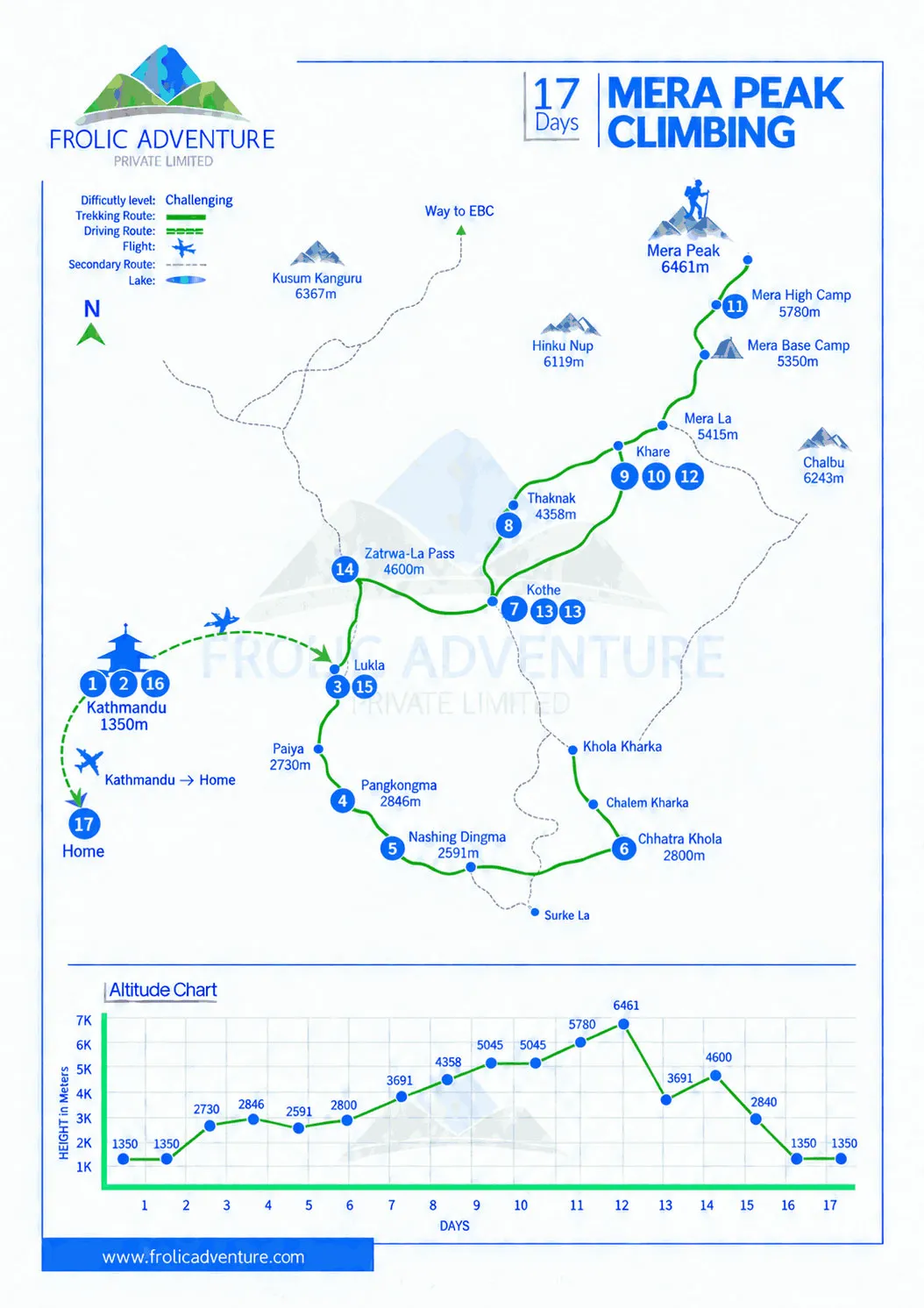
Route Map & Altitude Chart
Mera Peak Climbing
Trip Cost Details
- Airport pick-up and drop-off by private car/van/bus.
- 3 nights' Accommodation in a 3-star standard hotel, including breakfast, on a twin-sharing basis, per the above itinerary.
- All ground and domestic air transportation during the trip.
- Your standard meal BLD during the trek, with a cup of hot tea/coffee for breakfast
- All necessary paperwork, national park entry permits, TIMS cards, and climbing permits
- All accommodations in lodges/tea houses during the trek.
- Food, drinks, and a tented camp at the Island Peak base camp.
- An Expert trekking and climbing guide and a porter (one for 2 people)
- Regular climbing equipment.
- Salary, food, drinks, accommodation, transportation, and insurance for the guides.
- Your travel insurance company will cover arrangements for emergency helicopter service.
- Frolic Adventure invites you to a farewell dinner last night.
- All government taxes (GST) and Stationery expenses.
Private Trip
Essential Information
Accommodation, Food, and Drink in Mera Peak Route
The Mera Peak route has plenty of guesthouses with basic but comfortable accommodations. In Kathmandu, the journey begins with stays at hotels ranging from basic to luxurious, often in the vibrant tourist area of Thamel. As the trek progresses, accommodations shift to teahouses—simple, locally run lodges—offering basic facilities such as shared toilets and dormitory-style rooms. At higher elevations such as Khare (5,000 m) and Thangnak (4,350 m), the teahouses offer minimal amenities but remain clean and warm. At the Mera Peak High Camp (5,800 m), you sleep in tents set up for climbing. These tents are equipped with foam mattresses to ensure comfort in extreme conditions.
Meals along the route are hearty and energy-packed, crucial for sustaining you during the physically demanding climb. At lower altitudes, teahouses serve traditional Nepali dishes like Dal Bhat (lentils, rice, and vegetables) alongside other options such as noodles, momos, pasta, and even pizza. Meals are freshly prepared to meet nutritional needs, with breakfast and dinner typically served at the lodge where you stay, and you stop in between for lunch. During the camping phase at High Camp, meals are cooked by accompanying guides or cooks, with a focus on high-energy foods to prepare you for the summit push. Drinking water is available at tea houses or natural springs, but it often requires purification, a sterilizer, or boiling before you drink it due to safety concerns.
Climbing Difficulty Level of Mera Peak
Climbing Mera Peak is moderately difficult, primarily because of its high altitude and semi-technical terrain. You must not have advanced climbing skills for this peak. Still, you must navigate glaciers, steep icy slopes, and crevasses using basic mountaineering equipment like crampons, ice axes, and ropes. The summit push involves steep sections and thin air, making breathing and movement increasingly difficult. Altitude sickness is a significant risk, necessitating proper acclimatization through gradual increases in elevation and the "climb high, sleep low" approach. Additionally, you must be physically fit to endure long trekking days and mentally prepared for the demanding conditions.
Environmental factors can make Mera Peak more difficult. The unpredictable weather at high altitudes can bring sudden snowstorms, freezing temperatures, and strong winds that complicate navigation and increase risks, so always check the weather conditions before attempting the summit. The rugged terrain includes rocky paths and slippery snow-covered sections that require careful pacing and technical skills. You also face challenges in maintaining balance on icy stretches and avoiding hazards such as crevasses. Despite these obstacles, Mera Peak offers stunning views of the Himalayan range when you reach the top after being well-prepared with proper training, gear, and guidance from a climbing guide.
Make a Plan to Climb Mera Peak with a Few Spare Days
Planning to climb Mera Peak with a few spare days allows you a flexible, successful, and rewarding experience. Standing at 6,476 meters, Mera Peak is one of Nepal's highest trekking peaks and offers stunning views of Everest, Lhotse, Makalu, and other Himalayan giants. The typical itinerary includes acclimatization days at Khare (5,045m), where you can rest and undergo pre-climb training to prepare for the high-altitude ascent. You start walking towards the summit push from Mera High Camp (5,780m) around 2 AM, which ensures favorable weather conditions and avoids strong afternoon winds. The climb is non-technical but physically demanding due to the high altitude and icy path. Including spare days in your plan for the Mera Peak expedition is essential to account for unpredictable weather or physical setbacks, thereby increasing the chance of reaching the summit safely.
The extra days can also be used to explore the surrounding areas or enjoy additional acclimatization hikes, such as the Hinku Valley or nearby glaciers. These days provide an opportunity to immerse yourself in the serene beauty of the Himalayas while reducing the risk of altitude sickness. After summiting Mera Peak, spare days allow for a relaxed descent back to Lukla, ensuring you can fully savor your achievement without rushing. This thoughtful planning not only increases your chances of success but also enhances the overall experience of climbing one of Nepal's most iconic peaks.


Need Help? Call Us+977 9851043624