
12-days Everest Base Camp Helicopter Return Trek with 8-day walk, 1-day helicopter flight to Kathmandu, 2-day for arrival and departure, and 1-day for Kathmandu Cultural Tour and trekking preparation is the best for who do not want to walk on the same route returing from the base camp and experience both walk and areal views of the path walked and mountains from higher level that have seen from low angle while walking and reaches to the maximum elevation to 5,550 meters/ 18,519 feet (Kala Patthar) at starting cost 1950-2399 USD per person according to the number of trekkers in a group that includes Lukla flight and helicopter sharing flight from Gorakshep, all meal and guesthouse accommodations in the mountain, necessery trek permits, trek guide, and 3 nights 3 star hotel accommodation with breakfast in Kathmandu.
Helicopter Return Everest Base Camp Trek
A Quick Glimpse
- Trip Duration: 12 Days
- Trekking Duration: 9 Days
- Starting Point: Kathmandu
- Ending Point: Kathmandu
- Maximum Elevation: 5,550 meters (18,208 feet)
- Difficulty Level: Moderate to Strenuous
- Best Seasons: October to December and March to May
- Key Highlights: Mountain views, scenic flight to Lukla, scenic helicopter flight, cultural and religious monuments, traditional Sherpa villages with typical architectural houses and lifestyle, wildlife, high Himalayan valleys, massive glacier, and more
- Mountain Views: Everest, Lhotse, Makalu, Nuptse, Pumori, Ama Dablam, Thamserku, Changtse, and lots more
- Customizable: Yes
The Everest Base Camp Helicopter Return Trek is the shortest trekking itinerary that takes you to the base of the world's highest mountain and offers a scenic chopper flight and a high-altitude adventure walk in one trip.
This trip begins with a regularly scheduled small-plane flight to Lukla airport and ends with a scenic Heli Return flight to Kathmandu after you visit the base camp and Kala Patthar. Following the significant itinerary of the EBC, after landing at Tenzing-Hilary Airport, you walk to Phakding on the first day. After a one-night stay in Phakding, you visit Namche Bazaar on the second day, take one extra day for acclimatization, and hike to Hotel Everest View.
On the fourth day, you reach Tengboche, toward the Khumbu Valley. After Tengboche:
- Trek to Dingboche.
- Take the second altitude practice rest day during this trip in the Khumbu Region.
- Hike to Nangkartshang Hill.
Now, you go ahead to Lobuche on the 7th and Gorakshep on the 8th. From Gorakshep, you hike to the Base Camp of the world's tallest mountain. The 9th day is the last day of the Helicopter-Back EBC Trek, so you hike to Kala Patthar (5550m) from Gorakshep and then fly out to Kathmandu directly after breakfast.
Why Do We Recommend a Helicopter Return Trek from Everest Base Camp?
The Helicopter Return Trek from Everest Base Camp is recommended for time-bound travelers who do not have enough days to complete the regular 12-day trip or do not want to hike back the same way after visiting the base camp. It offers the best combination of a walking and scenic flight experience above the high mountains in the Everest Region, Nepal.
The 'Everest Base Camp Heli Back Trek' provides two different experiences. An adventure of walking at high elevation and a thrilling Helicopter Tour as a luxury scenic Heli-ride back to Kathmandu directly from the mountain
Trekking to Everest Base Camp in Nepal offers a fantastic mountain adventure. Along the way, you will see breathtaking views of magnificent snow-capped mountains, beautiful valleys, captivating landscapes, and other natural attractions. The warm hospitality of the locals in the region will give you extra emotional connections you may never forget.
An adventurous walk on the classic Everest Base Camp trail from Lukla, plus a helicopter return directly to Kathmandu from the mountain, gives you both adventure and luxury on this trip to Nepal. The regular Trek to the foot of the world's highest mountain takes eight days from Kathmandu, including two acclimatization rest days in Namche and Dingboche. Then, it returns to Lukla after three long days of walking. The traditional Base Camp Trekking itinerary is a 12-day round trip. If you do not want to use the same route back to Lukla or are not interested in walking those three long treks around, flying out by helicopter from Everest is the best trekking package for you.
The time-bound trekker may need help completing the usual itinerary. We present a quick Trekking package to explore this mountain region, starting with a walk to the base of Everest and ending with a helicopter flight out. After taking off from Gorakshep by aircraft, you may drop off in either Lukla or Kathmandu, depending on your time and interests.
Trekking to Everest Base Camp and flying back by Helicopter offers an exceptional experience for regular EBC trekkers, as those following a usual Trekking itinerary rarely get the opportunity to experience the luxury Helicopter Ride in the Himalayas.
Helicopter Return from Everest Base Camp is The Quickest and Luxurious Option
The Everest Base Camp Trek Return by Helicopter is Khumbu's quickest and most luxurious mountain journey. In a few days, you can explore this great Himalayan Region. The helicopter return trek is the best trekking package for a short holiday in Nepal, allowing you to reach the foot of the world's tallest mountain and see it up close.
The Heli Return Everest Base Camp Trek also saves time, allowing you to explore other beautiful historical places in the country. If you save days doing this fly-back EBC trek, you can go on a jungle safari, do a day tour in Kathmandu, and visit the beautiful lake city of Pokhara.
This Heli Return Trek is designed for those who love to experience adventure and thrilling flights in the Nepalese Himalayas. You will have a different experience flying over the high mountains, which you see standing impressively on the way to Base Camp. So, the views you see from land and by Helicopter provide a different experience from this Helicopter Return trek.
Book Everest Base Camp Trek Return by Helicopter with Frolic Adventure
Frolic Adventure operates the Everest Base Camp Trek Return by Helicopter. Our main goal is customer satisfaction, so we offer the best price and service. We arrange for experienced, informative guides and friendly helpers on the tour. We have a special offer for this EBC Heli Return Trek for group trekkers. You can easily book this fly-back Trek via the online payment link, or contact us if you book the trip as a group and require additional services beyond the package.
Helicopter Return Everest Base Camp Trek Itinerary
Arrival in Kathmandu (1,350 m)
Upon our arrival at the Kathmandu airport, we will be greeted and picked up by a Frolic Adventure representative. The representative will then take us to our hotel by private transport, and we will meet a company manager to discuss the trip. Then, we will be free today.
Trip Meeting and Trek Preparation Day (Optional, Kathmandu Cultural Heritage Tour)
You have a short meeting with our manager, who briefs you on the tour, what to take, and more. You will also meet your trek guide and prepare your trek equipment. Optionally, you can take a full-day Kathmandu Tour to visit four UNESCO Cultural Heritage sites rich in culture, art, and architecture. You will visit Kathmandu Durbar Square, Swayambhunath (Monkey Temple), Pashupatinath, and Bouddhanath, and learn a lot about ancient Nepalese history, the current situation, and more from our expert tour guide. This tour is highly recommended if you are interested in learning about Nepal beyond just enjoying nature. Overnight in the hotel.
Fly to Lukla (2,840 m) 30 minutes and trek to Phakding (2,610 m) 3 hrs
Our mountain trip begins today with an early-morning flight from Kathmandu Airport to Lukla on a small aircraft. It is a half-hour adventure flight that offers stunning mountain views of Langtang, Ganesh Himal, Gauri Shankar, and more.
Right after landing at Lukla Airport, we start walking toward Phakding. At the end of Lukla, we will issue a Khumbu Pasang Lhamu Rural Municipality entry ticket for 3000 NPR per person. It is our first day of trekking on descending trails, and we won’t be traveling long. We only walked for around three hours to reach Phakding. Before reaching Phakding town, we will pass through the villages of Chheplung, Thadokosi, and Ghat.
Trek from Phakding to Namche Bazaar (3,440 m) 6-7 hrs
We trek to Namche Bazaar today after breakfast. Today, we will be crossing five suspension bridges over the Dudhkoshi River. The Sagarmatha National Park starts from today’s trek. We will issue a National Park entry permit in Monjo after walking around 3 hours from Phakding. It costs 3000 NPR for this trekking permit, but for Indian trekkers, it is only 1500 NPR.
We stop in Jorsalle for lunch, then trek another three hours to Phakding. After crossing the highest suspension bridge, the trail takes about 2 hours to reach Namche Bazaar. Namche Bazaar is the most beautiful Sherpa town in the Everest region. Many lodges, grocery stores, trekking equipment shops, bakeries, coffee shops, and bars exist. We can hang around after refreshments and rest for a while.
Altitude practice rest day at Namche Bazaar
It is our first rest day for altitude practice here in Namche. It is not a complete rest day, as we hike for a few hours to the Everest View Hotel. We will pass through the highest airport, Syangboche, before reaching Everest View Hotel. Syangboche Airport is a rough airport, and it does not have regular flights.
We will see great views of Mt. Thamserku, Kusum Kanggaru, Khangteka, Amadablam, Lhotse, Nuptse, Kongde, and Everest. After enjoying panoramic Himalayan views from the Everest View Hotel, we will hike back to Namche.
Trek from Namche Bazaar to Tengboche (3,860 m) 5 hrs
An excellent and clear trekking trail runs for about two and a half hours after Namche Bazaar and continues to Kyangjuma. It is like a mountain highway maintained by an older man. He is collecting some donations from the trekkers and hiring laborers.
The trail divides after Kyangjuma: the Gokyo Valley trek to the left and the Everest Base Camp trekking route descending towards the riverside Phungki-Tenga. Here in Phungki-Tenga, we stop for lunch and climb for two more hours to reach Tengboche.
After resting, we will visit a historical ancient Buddhist monastery in Tengboche. There is a daily offering by the monks in the morning and after 3 pm. We can join the offerings and meditate with the monks.
Trek from Tengboche to Dingboche (4,410 m) 6 hrs
Tengboche is the best hill station from which to see the great view of Mt. Amadablam. It is the most beautiful mountain in the Himalayan range of Everest. After enjoying lovely mountain views in the morning, we have breakfast and trek further to Dingboche village.
We descend for about 20 minutes to Deboche through pine and rhododendron forests, then walk on a flat stretch for about 45 minutes. After that, we cross a bridge over the Khumbu River and ascend to Pangboche village. After an hour's walk from Pangboche, we reach Somare and have lunch. After lunch, we trek to Dingboche for another 1.5-2 hours. From this point, we will be walking above the tree line.
Rest day in Dingboche and hike to Nangkartshang peak (5,083 m)
It is our second acclimatization rest day. After breakfast, we will hike up to Nangkar-Tshang Hill for altitude practice. Nangkar-Tsang Hill is the only hill from which we can see Mt. Makalu, the fourth-highest mountain in the country and the fifth-highest globally.
Trek from Dingboche to Lbuche (4,910 m) 6 hrs
We trek along a flat stretch of a ridge for a few hours, keeping Pheriche Valley on our left. After walking for three to three hours, we reach Thukla, crossing a small river from the Khumbu glacier. We have lunch and ascend for about an hour until Thukla Top. We can see many memorials of dead climbers on the top of the Thukla Pass. The rest of today's trail to Lobuche from Thukla Pass is pretty straightforward, but we can feel the altitude.
Trek from Lobuche to Gorakshep (5,164 m) 3 hrs and hike to the base camp (5,364m) 4-5 hrs both way
Today is our most important day. We will hike to the base camp of the world’s highest mountain. We start trekking from Lobuche early in the morning, around 6-7 a.m. After walking for around three hours, we reach Gorakshep, the last place to stay. After having a quick lunch, we leave our luggage in the lodge and hike up to the base camp.
We only take snacks, water, and, of course, a camera to the base camp. The trail can be windy and cold, so we must wear warm and windproof gear. After visiting the base camp, we will hike back to Gorakshep and stay overnight.
Hike up to Kala Patthar (5,550 m) 2 hrs and Fly to Kathmandu on a helicopter, farewell dinner in the evening
The Everest Base Camp Trek is a special day with a helicopter return. We hike up to Kala Patthar, which offers a 360 ° view of the Everest massif and the closest view of Everest. We hike in the early morning, and it takes around two hours to reach the top.
Climbing Kala Patthar in the morning will be freezing, so we wear warm, windproof clothes with thermal layers. After enjoying the view, we hike back to our lodge, have breakfast, and be ready to fly out with our packed stuff.
After arriving in Kathmandu, we checked into the hotel, freshened up, and walked around if we wanted to. We will have a farewell dinner this evening with company managers invited by Frolic Adventure.
Final Departure to the international airport
Frolic Adventure provides private transport for our final departure to the international airport. We return home with a beautiful memory of the Everest Base Camp trek, a helicopter return, and say goodbye to Nepal until our next visit.
The Everest Base Camp trek with a helicopter return itinerary is 12 days. It can be customized to 10 or 11 days based on your physical fitness and time. 12-day Everest Base Camp trek with helicopter return includes one full-day Kathmandu city tour and 2 rest days for altitude practice during the trip.
The helicopter returns to ‘The Everest base camp trek and begins with a short flight on a plane from Kathmandu to a small mountain town, Lukla. Then, we will go to Phakding on the first day. After staying the first night in Phakding, we go to Namche Bazar on the second day and take the first acclimatization rest day. You will hike to the Everest View Hotel, passing the highest mountain airport, Syangboche.
On the fourth day, you will take the Everest Base Camp trek flight back with a helicopter to Tengboche, and on the fifth day, you will go to Dingboche. There will be a second day of rest in Dingboche, followed by a hike to Nangkar-Tsang Hill. After that, you will trek further to Lobuche on the 7th day, and to Gorakshep and the base camp on the 8th day, with a helicopter return.
On the 9th day, you will hike up to Kala Patthar early in the morning and fly back to Kathmandu on a helicopter to finish the flight back in the Everest Base Camp trek itinerary. You may contact us if you would like to do the customized Everest Base Camp trek with a flight-back trekking itinerary.
Route Map & Altitude Chart
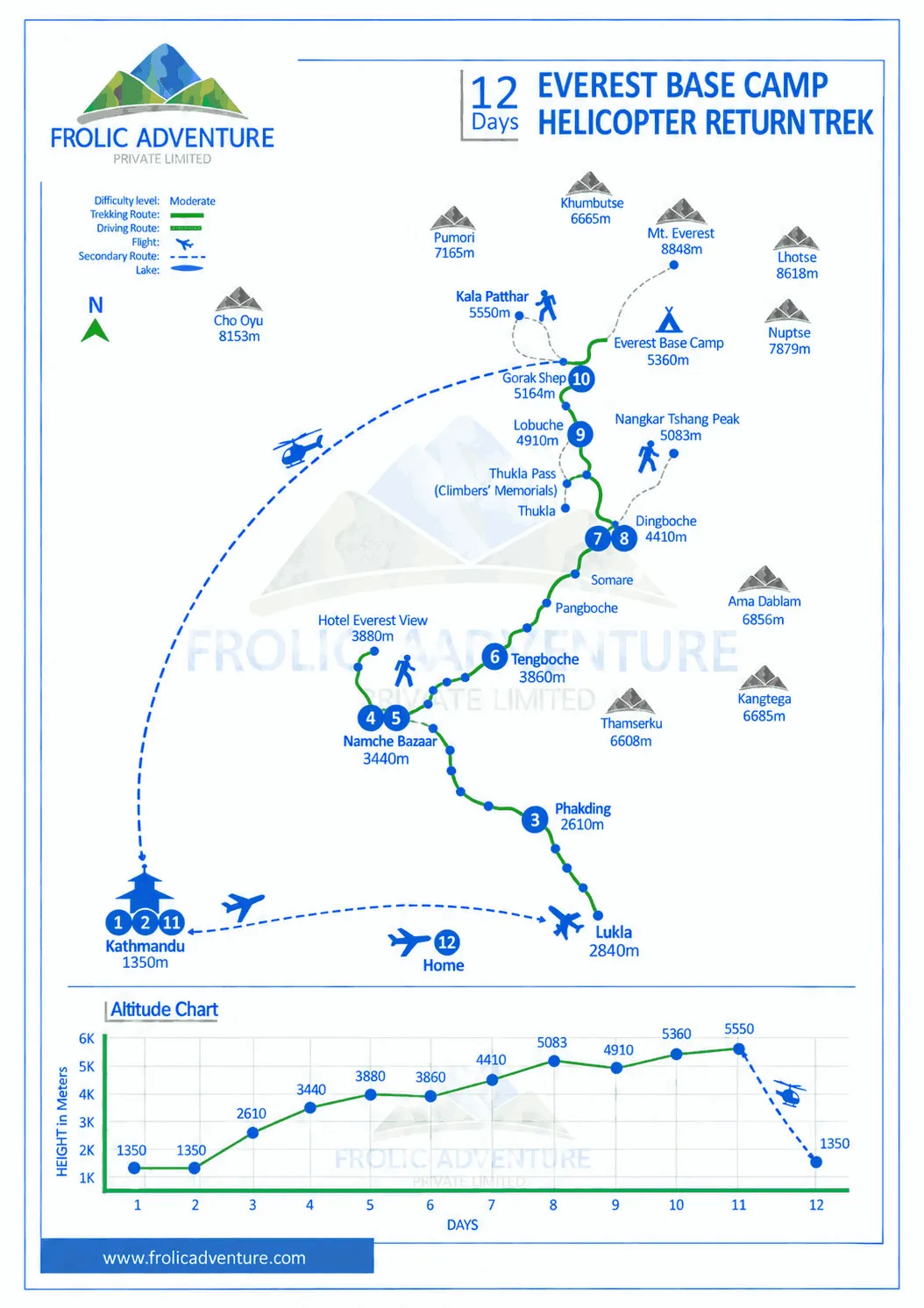
Trip Cost Details
- Airport pick-up and drop-off by private car/van/bus.
- 3 nights' accommodation in a 3-star hotel, including breakfast as per the above itinerary, on a twin-sharing basis.
- Sharing a Helicopter flight from Gorakshep to Kathmandu
- All the ground and domestic air transportation during the trip.
- Your standard meal BLD during the trek, with a cup of hot tea/coffee for breakfast
- All necessary paperwork, national park entry permits, and Pasang Lhamu fees
- All accommodations in lodges/tea houses during the treks.
- An experienced, helpful, and friendly guide and porter (one for two trekkers)
- Guide and porter salary, food, drinks, accommodation, transportation, and insurance.
- Farewell dinner last night in Kathmandu
- Your travel insurance company will pay for emergency helicopter arrangements.
- Certificate of achievement
- All government taxes (GST) and Stationery expenses.
Private Trip
Essential Information
Best Time for Everest Base Camp Trek with Helicopter Return
The 9-day Everest Base Camp Trek with Helicopter Return can be done in autumn and spring. These are the main trekking seasons in Nepal, making them the best times to trek the Nepalese Himalayas.
September to November and March to May are the best times for the EBC Heli Return Trek. However, there might be some rainy days until mid-September in the autumn and late May in the spring. So, from mid-September to the end of November and from March to the second week of May, this 9-day Trek is recommended for many trekkers.
December offers the best view and clear weather, but it is also the start of the winter season. It would be best to have excellent warm Trekking equipment for a winter 'Flight Back EBC Trekking.' But don’t try to trek during the summer months. The summer season has many rainy days—from June to August, and even into mid-September, the rainy season persists. We can say that mid-September to December and March to mid-May are the best times for the trip.
Trekking Gear for Helicopter Return Everest Base Camp Trek
You are jumping into a cold region, so you must have warm Trekking Gear for the 'Helicopter Return Everest Base Camp Trek.' You can never think of making the Everest Base Camp Trek with a Helicopter Flight Back without an excellent Trekking kit, so check out the essential packing list for a fly-back Trek with a Helicopter Return.
On a fly-back by Helicopter Tour, you will visit the same places and heights as on a 12-day Base Camp Trek. It requires proper Trekking equipment, as trekkers need the same equipment as on a 12-day EBC Trek. What source of trekking gear is essential, then? Check out the packing list for the trek here.
Helicopter Return EBC Trek Cost
The Everest Base Camp Trek with Helicopter Return is more expensive than the standard Trekking package because of the Flight Cost from Gorakshep. The Helicopter charges 6000 USD for the Gorakshep-to-Kathmandu flight, and only five people can fly in the morning. If it gets late, there will be wind, making it difficult for the Helicopter to carry full passenger loads. The listed cost is 1950 USD per person for a group of 5-10, for group sharing. But the Cost will be much cheaper if you are in a group. For a customized price for the Heli Everest Trek, please get in touch with us and let us know the number of visitors.
Four trekkers and a guide can fly from Gorakshep, and porters will return to Lukla. We only take bookings for groups of 2–5 trekkers, so the price varies by group size. Please note the price of a helicopter. Return from Everest before booking the trip. Check the trip cost according to the group size here:
Everest Base Camp Trek Return by Helicopter is a beautiful mountain journey, a lifetime walking experience, and a luxury flight above the high mountains. It is, of course, a delightful mountain trip, but there are some difficulties that trekkers will face. What are the problems with the trip? Check them out now:
Altitude Sickness
Altitude Sickness is the dominant difficulty of the Everest Base Camp Trek Return by Helicopter. It occurs because of the Himalayan lands' high oxygen levels and atmospheric pressure. Trekkers from sea level go directly to high mountain lands, which can cause mountain sickness because it takes time for their bodies to adjust to the rapidly changing altitude.
Flying to Lukla (2,840 m) is already high enough for sea-level people from Kathmandu (1,350m). There should not be any problems up to 4,000 m, but some trekkers may feel the effects of altitude after Namche Bazaar (3,440m). Altitude sickness symptoms, such as extreme headaches, dizziness, nausea, tingling fingers, loss of appetite, difficulty breathing while resting, feeling like a drunk, chest pain, and others, are typical for acute mountain illnesses.
You can prevent altitude sickness by drinking plenty of fluid, sleeping well, eating well, keeping warm, strolling, and having enough acclimatization rest days. You can also take your guide’s advice and locally available health assistance from the region. Altitude medication like Diamox can prevent AMS, but drink more water than usual after taking Diamox because it can cause dehydration.
Note: Don’t take any sleeping medication up in the mountains if you can’t sleep.
Changing Weather Can Affect the Trip Itinerary.
The weather in the Everest Region can change very quickly. There are four seasons in a day. A light shower or snowfall should not affect the Helicopter flight much if the visibility is clear enough. However, brief cloud cover and strong winds may occur even on a sunny day.
Even with a slight wind, the helicopter can’t take off from Gorakshep with many passengers. If this happens, the Helicopter might send two shuttles to the lower area and then fly together to Kathmandu later.
Flights flying towards Lukla should sometimes be canceled due to bad weather. If it happens, you must wait until the next day to fly. Also, it can affect return flights by Helicopter after the Base Camp. So, having extra days on the Everest Base Camp Trek with a Helicopter Return itinerary is a good idea.
Helicopter Return Trek Accommodation, Food, and Drink
Many hotels, guesthouses, and lodges are along the Everest Base Camp Trekking Trail. Some luxurious lodges are also available during the trek but are costly. Other regular accommodations are comfortable enough to stay in. You can get private accommodations at every stop. You can also expect attached bathroom accommodations in some places. Places like Tengboche, Lobuche, and Gorakshep have a limited number of lodges. You need to book your space in advance in those places if you are visiting during the high Trekking season.
You don’t need to eat local food during the 'Helicopter Return Everest Base Camp Trek.' You will have a food menu in every lodge. But you cannot expect food like in the city. The cooks are usually trained, and the food can taste different from place to place, even for the same items.
Mineral water bottles are sold in guesthouses and grocery shops. Bottled water is expensive in higher-elevation areas because of transportation costs. You can minimize your budget by not buying bottled water or tap water. However, remember to use purification tablets or sterilizers before drinking tap water.
Lukla Flight Leads Everest Base Camp Trek with Helicopter Return
The Everest Base Camp Trek with a Helicopter Fly-back starts with a plane ride into Lukla and ends with a Helicopter ride from Gorakshep. Lukla Airport is the only airport serving the Everest Region by plane. It is a gateway to the world's highest mountain.
There are regular flights from Kathmandu on clear days. The flights operate only in the morning because strong winds during the day make it difficult for the plane. Sometimes there may be flight delays or cancellations if visibility is poor due to clouds. So, it is better to have extra days in a Trekking itinerary in this case.
An important thing to know about the EBC Trek Return by Helicopter is the weight limitation on the flight. You can only take 15kg of weight, including your hand luggage. According to the airline, you can be charged an extra amount per kilo, about 100–200 NPR. But, due to overload, the luggage might not reach Lukla with you. The airline can put your bag on the next flight if the plane has enough load capacity. The next scheduled flight might not fly to Lukla if there is a sudden change in weather. We recommend packing only the needed Trek equipment and buying it for daily use along the Trek.
Hot Showers and Toilets During the Flyback Everest Base Camp Trip
Most places have proper hot showers, except for a few days in higher-elevated areas and places lacking water. You can get buckets of hot water in these places for hot showers. However, hot showers are inaccessible on the Everest Base Camp Trekking Route. The lodges charge 350 NPR to 600 NPR.
You may have seen photographs of the Tibetan wooden toilets along the Everest Base Camp Trekking Route shared by your friends who have already visited. Yes, these types of toilets exist, but they are not for you. They are mainly for the locals, not paying customers, along the walking trail.
There are sitting toilets in the lower areas but not in the higher ones. The temperature is freezing above 4000 meters on elevated terrain, and toilets freeze. Sometimes, the toilets keep stinking in higher areas. You don’t need to leave the building where you stay to use the bathroom. They are indoors and attached to accommodations in some places.
Internet, Communication, and Battery Charging on the Heli Return EBC Trek
There is a reliable internet connection for communication on the Heli Return EBC Trek. Cell phone signals are everywhere, even at Everest Base Camp. You can buy top-up Wi-Fi cards in the lodges and shops at every stop as an MB pack. To use this, you need to be closer to the router.
The best option for the trek is to use a SIM card for a cell phone. You can also call from anywhere and use the internet with data at Everest Base Camp. NTC and NCELL are two major cell phone service providers in Nepal. NCELL has better internet signals on the Everest Base Camp Trekking route.
There is electricity up to Tengboche and solar energy in the rest of the country. But you can charge your camera and other gadgets in your lodge. But battery charging is not free. Taking a spare camera battery and a high-volume power bank is better.
Stay Safe
Trekking in the high Himalayan Region is not always safe. The most important thing you must be careful of is altitude sickness. People could develop altitude sickness due to low oxygen levels and high atmospheric pressure. What are the symptoms of altitude sickness, and what should you do to prevent it? Check out details about altitude sickness here.
The Trekking trails to Everest Base Camp traverse narrow paths, cliffs, and slippery terrain. You need to walk carefully on those parts. You will meet porters and animal transporters to supply food during the Trek. Please stay safe if you meet them in a narrow area closer to the cliff. Mistakenly, the load might push and cause an accident. If you meet other people or animals while crossing suspension bridges, you must wait until others have crossed or passed first, depending on the situation. And be careful while taking pictures of wild animals and animal transportation.