
Everest Base Camp and Gokyo Lakes Trek crossing Cho La Pass 18 days trip with 14 days actual walkking Itinerary, where two acclimatization rest days is an adventure trekking in the Everest Region, that takes to the maximum elevation 5,550 meters / 18,208 feet, Kala Patthar, and costs 1400-1699 USD for a full board, includes domestic flights to and from Lukla, 3 nights hotel accommodation with breakfast in Kathmandu, all meal and guesthouse accommodation in mountain, all trek permit, and experienced guide.
Everest Base Camp and Gokyo Lakes Trek
Trip Facts
Duration
18 Days
Trip Grade
Moderate to Strenuous
Country
Nepal
Maximum Altitude
5,550 meters
Starts
Kathmandu
Ends
Kathmandu
Group Size
1-10
Activities
Trekking and Cultural Tour
Best Time
October to December and March to May
A Quick Glimpse
- Trip Duration: 18 Days
- Trekking Duration: 14 Days
- Starting Point: Kathmandu
- Ending Point: Kathmandu
- Maximum Elevation: 5,550 meters (18,208 feet)
- Difficulty Level: Moderate to Strenuous
- Best Seasons: October to December and March to May
- Key Highlights: Mountain views, tranquil lakes, adventure high pass, Everest Base Camp, Massive Glaciers, rivers, waterfalls, cultural and religious monuments, beautiful valleys, Sherpa villages and lifestyle, and wildlife
- Mountain Views: Everest, Lhotse, Nuptse, Cho-Oyu, Makalu, Ama Dablam, Pumori, and lots more
- Customizable: Yes
The Everest Base Camp and Gokyo Lakes Trek via Cho La Pass is in the Solukhumbu Everest Region. During this Trek, you visit the world's highest mountain base camp, two different viewpoints (Gokyo Ri and Kalapatthar) to see eye-catching mountain views, and tranquil Gokyo Lakes, with the adventure experience of crossing Cho La Pass (5420 m).
It is a combined Trekking package that combines two routes: Everest Base Camp and Gokyo Lakes. You can see four high mountains above eight thousand meters. Everest, Lhotse, Makalu, and Cho-Oyu are four of Nepal's eight mountains. Beautiful glacial lakes, landscapes, valleys, flora, and fauna add prettiness to this Cho La Pass Adventure Trek.
Trekking to the Gokyo Lakes with Everest Base Camp via Cho La Pass after visiting the base camp begins with the regular EBC trail for a few days up to the bottom of Mt. Everest and Kalapatthar, then goes to Zongla for Cho La. During this adventure, you will see two giant glaciers, Khumbu and Ngozumpa. You will make a circle during this Gokyo Everest Base Camp Trek, which means you only need to trek back on the same route except for the last day from Namche to Lukla.
Once you leave the regular Base Camp route and take a right toward Cho La, the trail will be quieter and have much fewer trekkers. You spend a night in Zongla before crossing Cho La. It would be best to start early in the morning to cross the Pass and avoid the wind, and reach the next destination on time. You get to Thangnak for lunch after crossing Cho La. After lunch, you can stay at this place or Trek to Gokyo in the afternoon. It takes another two hours to reach Gokyo from Thangnak and cross the colossal glacier Ngozumpa.
You can visit the 5th Lake or Gokyo Ri the next morning. If you have one day in Gokyo, visit Gokyo Ri because it offers magnificent mountain views—probably the best of the Everest Himalayas, lakes, and glaciers. Visiting the 5th Lake is a full-day excursion, so we recommend taking snacks from the lodge before heading on. From this place, you can see the whole body of Mt.Everest, so if you have extra days, visiting the 5th Lake can be worthwhile.
The lodges are close to the 3rd Lake, but the 4th and 5th are toward the north. You will pass the 1st and 2nd lakes while walking toward Dole after Gokyo. You see ruddy shelducks around these lakes. Today, you walk through Fanga, Machchhermo, and Luza before you arrive at Dole to stay.
After Dole, you descend for around an hour through rhododendrons and pine forests. There are some beautiful ice-climbing sites where people climb in winter. You can also see musk deer inside this forest while descending to Phungki-Tenga. After Phungki-Tenga, the trail goes upward for about an hour and a half to Mong Danda. There are Himalayan Thars (wild Himalayan goats) around the walking path. You can see celestial views of Mt.Thamserku, Khangteka, and Amadablam from this hill, and then you can start descending towards Sanasa, where the Everest Base Camp trail joins back. Today, you reach Namche Bazaar, and the following day you reach Lukla before flying to Kathmandu.
Frolic Adventure managers are well-informed about the Trek and update you about any changes in the route, so you can always get factual information before you book your Cho La Pass Adventure Trek. We are a legally authorized trekking operator from the Nepal Tourism Board (NTB), providing government license holders with English-speaking guides and helpful, friendly assistance.
What to expect from the Everest Base Camp Gokyo Lakes Trek via Cho La Pass
- You will be walking through different Himalayan valleys, such as the Dudhkoshi River Valley, the Khumbu Valley, the Imja Valley, and the Gokyo Valley, with mind-blowing mountain views most of the time.
- Natural beauties such as Rivers, waterfalls, and vegetation from the Sagarmatha National Park (a UNESCO World Heritage Site) graced the EBC Gokyo Trekking route.
- The Sherpas are world-famous for mountain climbing. You can experience their lifestyle, activities, culture, and traditions, along with great hospitality.
- Unreal mountain views from vantage viewpoints such as Hotel Everest View, Tengboche Hill, Nangkar-Tshang Hill, Kalapatthar, and Gokyo Ri make you feel like you are in absolute heaven while doing the EBC Gokyo Trek via Choa La Pass.
- Step to the foot of the world's tallest mountain and reach very close to the famous Khumbu Icefall.
- Explore the balmy Gokyo Lakes and glacial ponds, and cross giant glaciers with a moonwalk-like feeling.
- You can see wildlife such as Himalayan Thar, musk deer, and Himalayan pika, as well as birds such as mountain hawks, ravens, Tibetan snowcocks, golden Brahminy ducks, and Himalayan Monal.
- Visit the ancient Buddhist monastery and join the monks for regular offerings.
- Meet the Everest climbers in the spring.
Everest Base Camp Gokyo Lakes Trek via Cho La Pass: Who can go on this Trek?
The 'Everest Base Camp and Gokyo Lakes Trek via Cho La Pass' is a challenging mountain trek. It could have similar difficulties as the Base Camp Trek most of the time, but this high Pass makes it more adventurous and challenging. If you are a regular hiker and have visited places higher than 4000 meters above sea level several times, it should not be a problem. However, if you are a first-time trekker, we suggest short treks in Nepal or the other Himalayas before attempting the Cho La Pass Trek.
The Altitude and thin air make breathing difficult in the high Himalayan region. Ice is on the trail near the Cho La Pass; even a bunch of it sometimes heaps up. It is strenuous to walk around the top of this hill.
Going over the Cho La Pass from the Gokyo side to the Base Camp
You might have seen different trekking itineraries for the Everest Gokyo Trek that go through Cho La Pass and need clarification on which routes are better. For your information, visiting the Base Camp first and going to the Gokyo Lakes later is a more accessible itinerary because you will have less climbing. If you go over the Pass from Zongla, you feel like you're only climbing a little, but the stretch from Thangnak is a tiring uphill climb for many hours. But if you have knee problems from a long downhill walk, crossing from the Gkyo side is recommended.
Also, starting early in the morning with a flashlight to cross Cho La from Thangnak would be best. If you first go for the Pass from Zongla after the Base Camp, you can start with daylight. Although you have to start earlier than the other regular Trekking days,
How do I prepare for an adventure trek to Everest Base Camp with a stop at the Gokyo Lakes?
Everyone who dreams of trekking in the Himalayas can complete the Everest Base Camp with Gokyo Lakes trek, but they need some hiking and altitude practice. You can often hike in nature, where the trails wind up and down hills, and visit high elevations above 4,000 meters on short treks. Those who do not have hills and mountains for hiking and Trekking in their country can do indoor practices with high atmospheric pressure, such as running and jogging.
Hill hikes, weightlifting, running, and jogging strengthen and flex your muscles for walking in the high Himalayan region. In the Everest Himalayan Region, prepare to carry a few kilograms in your daypack for 6-7 hours of walking daily over 15–16 days.
In addition to physical preparation, you must also mentally prepare to Trek to Everest Base Camp via the Cho La Pass, including the Gokyo Lakes. Be ready to face any difficulties during the trip, such as changing weather, what to do if the Lukla flight is canceled, staying in basic lodges with no daily showers, and altitude sickness.
Book Everest Base Camp to Gokyo Lakes Trek via Cho La Pass with Frolic Adventure.
After learning about Trekking from Everest Base Camp to Gokyo Lakes via Cho La Pass, you can explore the beauty of this Himalayan region. We are taking bookings for this adventure trip to Everest for 2026 and 2027, so you can secure your seat now.
You can book the trip directly through the 'book this trip' section or the contact us page with any trip-related questions. We offer a special discount for group trekkers to the Everest Gokyo Lakes and are ready to customize itineraries according to your time frame and physical fitness.
Everest Base Camp and Gokyo Lakes Trek Itinerary
Day 1
Kathmandu Arrival (1,350 m / 4,429 feet)
Our representative will warmly receive you upon your arrival at the Tribhuvan International Airport in Kathmandu. He will escort you to your hotel. After the trek orientation and meeting your guide, you can choose to relax or take a stroll through the market to shop for any needed trek accessories, gear, or goodies. Overnight stay at a hotel in Kathmandu.
Max Altitude: 1,350m (4,429ft)
Accommodation: 3 Star Hotel
Mode of Transportation: Private Car/Jeep/Van
Day 2
Pre-Trip Meeting and Trek Preparation Day (Optional, Kathmandu Cultural Heritage Tour)
Today, you have a short meeting to talk about the trip with our manager and fee for a wlole day, so we suggest for 5-6 hour's Kathmandu Heritage Tour, which is worth doing it to know About ancient Nepalese history, culture, lifestyle, religion, art, architecture, ethnic groups, and more including recent changes in politics, progress, and development with geographical structure of the country before you head on to explore beautiful nature of Everest Region. You will visit four UNESCO World Heritage Sites: Kathmandu Durbar Square (Hanuman Dhoka Palace), Swayambhunath (Monkey Temple), Pashupatinath (Open Cremation), and Boudhanath during this cultural tour and stay overnight in the hotel after managing and packing trekking gear.
Max Altitude: 1,350m (4,429ft)
Meals: Breakfast
Accommodation: 3 Star Hotel
Day 3
Fly to Lukla (2,840 m / 9,317 feet) and trek to Phakding (2,610 m / 8,562 feet) 3 hrs.
After an early morning breakfast, you’ll embark on a scenic 40-minute flight to Lukla. Lukla is a small Sherpa town in the Solukhumbu district of Nepal. Because there is a domestic airport, it serves as the gateway to the Everest region. Once at Lukla, you’ll rest briefly and embark on the first day of the trek to the nearby town of Phakding, which is only 6.2km north of Lukla. Overnight stay in Phakding.
Max Altitude: 2,610m (8,562ft)
Altitude Gain: 1490
Altitude Loss: 230
Duration: 3 Hours
Distance: 7.5-8 KM
Meals: Breakfast+Lunch+Dinner
Accommodation: Guesthouse
Mode of Transportation: Domestic Flight_Private Car/Jeep/Van
Day 4
Trek from Phakding to Namche Bazaar (3,440 m / 11,286 feet) 6 hours.
Starting from Phakding, you’ll trek through the Jorsalle village towards the Dudh Koshi Valley. Monjo village is a bit further down the road, which is also the entry point for Sagarmatha National Park. You will witness some of the rarest flora and fauna inside the national park. A bit further inside the park lies Namche Bazaar. The place, bustling with locals and tourists, is the largest Sherpa town in the entire region. Overnight stay at Namche Bazaar.
Max Altitude: 3,440m (11,286ft)
Altitude Gain: 830
Duration: 6-7 Hours
Distance: 10-12 KM
Meals: Breakfast+Lunch+Dinner
Accommodation: Guesthouse
Mode of Transportation: Walk
Day 5
Rest and acclimatization day at Namche and Hike to Hotel Everest View (3,880 m / 12,729 feet) 3-4 Hrs.
Today, you’ll spend time acclimatizing at Namche Bazaar. You’ll briefly hike to the villages of Khumjung and Kunde to get used to the altitude. Khumjung is a Sherpa village famous for the ‘Khumjung Hillary School’ and Khumjung Monastery, where the supposed Yeti’s scalp is preserved in a glass box. Kunde is another Sherpa village near Namche. It is known for its hospital, established in 1966. Afterward, you’ll return to Namche. Overnight stay at Namche Bazaar.
Max Altitude: 3,440m (11,286ft)
Altitude Gain: 440
Altitude Loss: 440
Duration: 3-4 Hours
Distance: 3-5 KM (Round)
Meals: Breakfast+Lunch+Dinner
Accommodation: Guesthouse
Mode of Transportation: Walk
Day 6
Trek from Namche Bazaar to Tengboche (3,860 m / 12,664 feet) 5-6 hrs.
Today, you’ll trek from Namche Bazaar to Tengboche village. From Namche, you will head upwards through Phunki Tenga village and ascend to Tengboche. Tengboche is one of the most famous Sherpa villages, known for the Tengboche Monastery, the largest Buddhist monastery in the region. Tengboche Monastery hosts the annual Mani Rimdu festival and offers beautiful views of Ama Dablam (6,856 m). Overnight stay at Tengboche.
Max Altitude: 3,860m (12,664ft)
Altitude Gain: 420
Duration: 5-6 Hours
Distance: 9.2-10.7 KM
Meals: Breakfast+Lunch+Dinner
Accommodation: Guesthouse
Mode of Transportation: Walk
Day 7
Trek from Tengboche to Dingboche (4,410 m / 14,468 feet) 5-6 hours.
From Tengboche, the trail drops to the village of Debuche. You’ll cross the Imja Khola to reach Pangboche. Thousands of Mani stones (Revered Stones with Buddhist iconography) dominate the landscape here. After a few hours of uphill trek, you’ll reach the Sherpa village of Dingboche. From here, you can get an up-close view of the surrounding peaks, namely Lhotse (8,414 m), Island Peak (6,189 m), and Ama Dablam (6,856m). Overnight stay at Dingboche.
Max Altitude: 4,410m (14,468ft)
Altitude Gain: 550
Duration: 5-6 Hours
Distance: 10-11 KM
Meals: Breakfast+Lunch+Dinner
Accommodation: Guesthouse
Mode of Transportation: Walk
Day 8
Acclimatization day at Dingboche and Hike to Nangkartshang Peak (5,083 m / 16676 feet) 3-4 Hrs.
Today, you acclimate to the rapidly thinning air and Himalayan biomes at Dingboche. The settlements of Dingboche reflect the rich Sherpa practices through the locals' lifestyles and monasteries. The surrounding sites in the village also offer some of the most mesmerizing Himalayan views. You rest and adjust your body as you interact with the locals. Overnight stay at Dingboche.
Max Altitude: 4,410m (14,468ft)
Altitude Gain: 673
Duration: 3-4 Hours
Distance: 5-7 KM
Meals: Breakfast+Lunch+Dinner
Accommodation: Guesthouse
Mode of Transportation: Walk
Day 9
Trek from Dingboche to Lobuche (4,910 m / 16,108 feet) 5-6 hours.
Today, you’ll advance on a short hike to the village of Chhukung. Chhukung is essential for the alpinists heading towards Island Peak (6,189 m) or Lobuche Peak (6,119 m). You’ll encounter numerous summer huts prepared especially for keeping livestock during the summer. From Chhukung, you’ll ascend along the moraine of the Khumbu Glacier towards Lobuche village. Overnight stay at Lobuche.
Max Altitude: 4,910m (16,108ft)
Altitude Gain: 500
Duration: 5-6 Hours
Distance: 7-8 KM
Meals: Breakfast+Lunch+Dinner
Accommodation: Guesthouse
Mode of Transportation: Walk
Day 10
Trek to Everest Base Camp (5,364m.) via Gorakshep (5,164 m / 16,994 feet) 7-9 hrs. in total.
From Lobuche, you’ll go up to the village of Gorakshep. Gorakshep is a semi-permanent settlement before Kalapatthar (5,550 m) and Everest Base Camp (5,364 m). The trail goes along the Khumbu Glacier. Due to the high altitude, there is little or no vegetation. You’ll make a short hike to Everest Base Camp. After exploring the base camp, you’ll make your way down to Gorakshep for the overnight.
Max Altitude: 5,164m (16,942ft)
Altitude Gain: 454
Altitude Loss: 200
Duration: 7-9 Hours
Distance: 12.5-13.5 KM
Meals: Breakfast+Lunch+Dinner
Accommodation: Guesthouse
Mode of Transportation: Walk
Day 11
Hike to Kalapatthar (5,550 m /18,208 feet), trek to Dzongla (4,830 m / 15,845 feet) 4-6 hrs.
Today, you’ll start early and make your way toward Kalapatthar. The trail weaves through ice pinnacles and across the crevasses of the Khumbu Glacier towards the top. You can see Mount Everest (8,848 m) from the top, which is generally not visible from the base camp. You will also get a panorama of the entire valley from the top of Kalapatthar. After a brief layover, you’ll go down to Dzongla village. Overnight stay at Dzongla.
Max Altitude: 4,830m (15,846ft)
Altitude Gain: 386
Altitude Loss: 720
Duration: 4-6 Hours
Distance: 10.8-11.5 KM
Meals: Breakfast+Lunch+Dinner
Accommodation: Guesthouse
Mode of Transportation: Walk
Day 12
Trek from Dzongla to Dragnag (4,700 m / 15,419 feet) via Cho La Pass (5,360 m / 17,585 feet) 6-8 hrs.
You'll be greeted with the view of Cholatse Peak (6,335 m) in the morning. Trekking west of Dzongla, the trail descends to a basin across the icy landscape. After an hour's trek, you'll begin the climb of Cho La Pass (5,420 m). As you gain altitude, Cho La Lake and Ama Dablam (6,856 m) appear in the distance. The final ascent to Cho La Pass in Everest can be tricky, as the trail curves around the bergschrund. The top of Cho La Pass offers scenic views of the surrounding landscape. From here, you'll descend to the village of Dragnak. Overnight stay in Dragnak.
Max Altitude: 4,700m (15,419ft)
Altitude Gain: 530
Altitude Loss: 660
Duration: 6-8 Hours
Distance: 8-10 KM
Meals: Breakfast+Lunch+Dinner
Accommodation: Guesthouse
Mode of Transportation: Walk
Day 13
Trek from Dragnag to Gokyo (4,790 m / 15,715 feet) 2-3 hrs.
The trail from Dragnag goes past the Ngozumpa Glacier, the longest glacier in Nepal. On the other side of the glacier lies Gokyo village. You’ll encounter Dudh Pokhari, the largest lake in the region, with a series of 6 lakes beyond it. The lake is magnificent in appearance and offers the best display of the Himalayas in the Everest region. Overnight stay at Gokyo.
Max Altitude: 4,790m (15,715ft)
Altitude Gain: 90
Duration: 2-3 Hours
Distance: 4-5 KM
Meals: Breakfast+Lunch+Dinner
Accommodation: Guesthouse
Mode of Transportation: Walk
Day 14
Hike to Gokyo RI (5,360 m / 17,585 feet) and trek down to Dole (4,110 m / 13,484 feet) 5-7 hrs.
The day is specially sanctioned to ascend Gokyo Ri (5,360 m) and later head to Dole. The hike to the top of Gokyo Ri begins as you run out of the village and hug the steep trail to the top. The summit offers a majestic panorama of the snow-clad mountains in the Everest region. Later, you trek to Dhole, crossing the Renjo La Pass (5,360m). The pass is similarly sublime in its grand display of mountains in the Kongde and Kangchung ranges. Later, you head to Dole. Overnight stay at Dole.
Max Altitude: 4,110m (13,484ft)
Altitude Gain: 570
Altitude Loss: 1250
Duration: 5-7 Hours
Distance: 11-12.5 KM
Meals: Breakfast+Lunch+Dinner
Accommodation: Guesthouse
Mode of Transportation: Walk
Day 15
Trek from Dhole to Namche Bazaar (3,440 m / 11,286 feet) 5-7 hrs.
This day includes a relatively short trek to Namche Bazaar. From Dhole, the trail heads to Tenga and then to Phortse Tenga. Following the Dudh Koshi River, you descend past monasteries and shorten the route to reach Chipcho. Further ahead from Chipcho, you follow the trail through Khumjung village and reach Namche Bazaar. Overnight stay at Namche Bazaar.
Max Altitude: 3,440m (11,286ft)
Altitude Loss: 670
Duration: 5-7 Hours
Distance: 11 KM
Meals: Breakfast+Lunch+Dinner
Accommodation: Guesthouse
Mode of Transportation: Walk
Day 16
Trek from Namche Bazaar to Lukla (2,840 m / 9,317 feet) 6-7 hrs.
Today is the final day of the trek. You’ll start descending from Namche and make your way toward Lukla. You’ll walk along the Dudh Koshi River through the Monjo and Phakding villages towards Lukla. Once at Lukla, you can throw a small party and celebrate the completion of the Gokyo Chola Pass trek with your staff and colleagues. Overnight stay at Lukla.
Max Altitude: 2,840m (9,317ft)
Altitude Loss: 600
Duration: 6-7 Hours
Distance: 18-20 KM
Meals: Breakfast+Lunch+Dinner
Accommodation: Guesthouse
Mode of Transportation: Walk
Day 17
Fly back to Kathmandu and have a Farewell dinner with the company.
Today is the last you’ll see of the serene mountains. Once on the flight, you can catch the last glimpse of the mountains in the Everest region and make your way toward Kathmandu. Your guide will take you back to your hotel in Kathmandu. You can rest and enjoy the hotel's wellness services. Overnight stay at a hotel in Kathmandu.
Max Altitude: 1,350m (4,429ft)
Altitude Loss: 1490
Duration: 30 Minutes
Distance: 135 KM
Meals: Breakfast+Dinner
Accommodation: 3 Star Hotel
Mode of Transportation: Domestic Flight+Private Car/Jeep/Van (Ramechhap-Kathmandu Transport is Sharing)
Day 18
Departure to international airport for your final flight.
We’ll drop you off at Tribhuvan International Airport so you can catch your scheduled flight back home. Our representative will take you to the airport, approx. 2 hours early. You can share your trip experience or your next adventure with us on the way.
Meals: Breakfast
Mode of Transportation: Private Car/Jeep/Van
The Everest Base Camp Trek via Cho La Pass itinerary is 19 days long and includes a Kathmandu city tour and some acclimatization days in the mountains. We also make a customized Cho La Pass trek itinerary. Please tell us how long your holidays are. And how adventurous are you? We make a 15-day Cho La Pass trek itinerary, the 14-day EBC Gokyo Lakes trek itinerary, the Cho La Renjo La Pass trek itinerary, the Everest Base Camp Gokyo Lakes trek itinerary, and more, according to your order.
Are you still confuse from where to start?
No worries - Our team is ready to guide you!
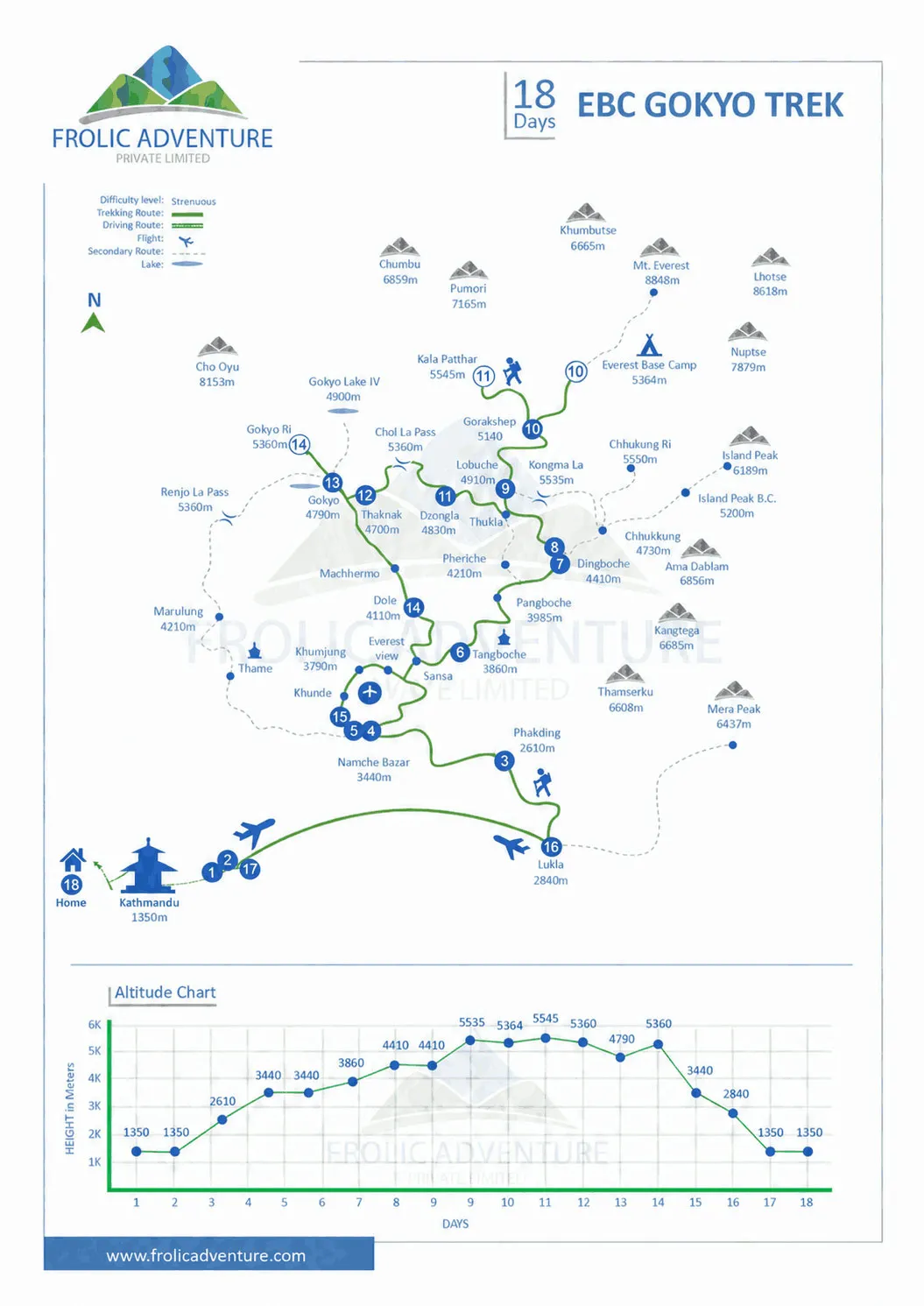
Route Map & Altitude Chart
Everest Base Camp and Gokyo Lakes Trek
Trip Cost Details
- All airport transport in Kathmandu (If you have a flight from Ramechhap, it costs extra)
- 3 nights' accommodation in a 3-star hotel in Kathmandu with breakfast
- Domestic flight Kathmandu-Lukla-Kathmandu for you and your guide
- Your standard meal BLD during the trek, with a cup of hot tea/coffee for breakfast
- All necessary paperwork, national park entry permits, and Pasang Lhamu entry fees
- All accommodations in lodges/tea houses during the treks.
- An experienced, helpful, and friendly guide and porter (one for two trekkers)
- Salary, food, drinks, accommodation, transportation, and insurance for the guide and porter.
- Your travel insurance company will pay for emergency helicopter arrangements.
- Frolic Adventure invites you to a farewell dinner last night.
- All government taxes (GST) and Stationery expenses.
Private Trip
Essential Information
Gokyo Everest Base Camp: When is the best time to Trek?
October to December and spring (March to May) are the best times to Trek to Gokyo Everest Base Camp. However, the first two weeks of September and the last two weeks of May might have some rainy days.
December in winter is not a bad time to Trek, but the temperature will be freezing. Pack extra warm equipment for the December Cho La Pass trail visit. This month, the mountain region of Nepal usually has clear weather throughout the day, from morning to evening. January through mid-February is the coldest time, and temperatures start warming up after mid-February. But it may snow at this time, making it challenging to cross Cho La. Although there might be snow sometimes during the beginning of spring,
If you want to see unfrozen Gokyo Lakes, September to December is the best time to visit Gokyo Valley. They freeze in the winter and melt in the late spring. You can meet many Everest climbers and Sherpas during the spring Trek to Gokyo EBC.
Likewise, summer couldn't be better for Trekking in the Nepalese Himalayas and the Base Camp Gokyo Lakes route. However, there are many rainy days during this time, and there may not be regular daily flights to Lukla. Driving on the road to Salleri and Jiri might trigger landslides.
Everest Gokyo Lakes: Accommodation, Food, and Drinks During the Trek
There are lots of lodges on the Everest and Gokyo Valley Trekking routes. Most guesthouses are average, but you will have a private room with comfortable beds and a clean bed sheet. You also have some luxury lodges in the lower regions that are open for a few days, but they are expensive. Our trekking package incurs an extra cost for staying in those luxurious places.
You must have food in the same lodge you stay in during the Trek. You have a food menu, so you can choose any main course. It means you don't always need to stick to local food; you can also get local food if you want to try it.
Water bottles are available, but the cost increases at higher elevations. Although mineral water is better in two places, Lobuche and Gorakshep, tap water is available in most areas. However, you must use purification tablets or a sterilizer before drinking it.
Hot Shower, Battery Charging, and Internet Service
You will get gas showers in most places, but it will be challenging to get one when the temperature drops to minus degrees. The lodges provide a hot bucket for bathing in some places, if you would like. However, there are always proper gas showers in the lower areas of the Gokyo Everest base camp tour. You must pay for hot showers in the Himalayas.
On the fourth day of the Trek, you cross Tengboche without electricity. The lodges use solar power for the lights and battery charging. Battery charging is expensive in higher-elevation areas, although you get free charging for the first three and last two days of this trip. We recommend bringing a power bank and a few extra camera batteries.
For internet use, you can buy a top-up card from the Everest Link wifi service, which you can buy in the lodges where you stay if you buy NCELL or NTC with internet data from Kathmandu. It is better to use it than buy the Everest Link card. Please kindly check the shower and toilets here.
Respect Religion and culture.
People from the Everest Region follow Buddhism strictly. They do not even like to see anyone killing animals. You can see lots of Tibetan snowcocks. Those birds are considered holy, so do not talk about bad things or make jokes about killing them for dinner. People become angry when they hear such words.
Along the Everest-Gokyo Lakes trek, you will see many Buddhist monuments, such as Mani wheels and rocks with mantras. If the trail is okay, please walk on the left side, keeping them on your right. You are not allowed to wear shorts when you enter the monastery.
Altitude sickness while trekking to the EBC Gokyo Lakes
Knowing about altitude sickness is essential when walking at high Himalayan elevations and around the EBC and Gokyo Lakes. Altitude sickness can be hazardous if you are unaware of its symptoms and complications. However, it is not very dangerous if you are well-acclimatized and stop ascending higher elevations with severe symptoms.
Altitude sickness is caused by low oxygen levels in the high Himalayan territories. It mainly affects the lungs and brain, causing pulmonary and cerebral Edema. Most trekkers experience problems with just one of them, but some have both.
To prevent high-altitude sickness, having at least two altitude-practice rest days during the Everest Gokyo Trek via Cho La Pass is advisable. We recommend drinking fluids, strolling, and keeping warm during the tour. Do not try to go higher if you have early symptoms, even if you have medicine. According to the conditions, it is better to descend to a lower elevation or rest another day at the same place. Here are some details about AMS!
Do not travel with a tight trekking itinerary on Everest or Gokyo Lakes.
Trekking to the Everest Base Camp and Gokyo Lakes begins with a flight from Kathmandu or Ramechhap (Manthali) to Lukla. The weather determines whether you can Fly on a regular schedule. Flight difficulties apply not only to the inbound flight but also to the outbound flight after the Trek.
Travel to EBC Gokyo with a tight itinerary. You may need more time to complete the trip or even miss an international flight due to adverse weather conditions. We recommend having a few extra days for the journey. If you have no problem with the weather, you can use your free days in Kathmandu for some day tours or hikes. What happens if the flight is delayed or canceled? Please check here!

Need Help? Call Us+977 9851043624